What Compensation Can You Recover for a Hawaii Personal Injury Case?
The aftermath of a personal injury accident almost always involves massive, unexpected bills—bills for hospital stays, specialized surgeries, vehicle repairs, prescription medications, and long-term rehabilitation. If you are drowning in expenses following an accident caused by another party’s negligence, you have the legal right to seek financial recovery.
At Rosenberg Hoffman, we understand that securing maximum financial compensation is not just about paying off immediate debt—it is about protecting your family’s future and ensuring you have the resources to fully heal. Since 1995, our Honolulu-based team has been fighting relentlessly for the rights of accident survivors across Oahu. When we take on your case, we investigate every available avenue of recovery, and we do not stop fighting until we have pursued every bit of compensation available under Hawaii law.
The Rosenberg Hoffman Advantage: Maximizing Your Claim's Value
Calculating the true value of an injury claim requires deeply personalized attention. Unlike high-volume firms where files are passed to case managers or paralegals, you will always work directly with your Rosenberg Hoffman attorney. We collaborate closely with you, your healthcare providers, and economic experts to accurately document every single loss you have suffered, ensuring the insurance companies do not shortchange your recovery.
Understanding Damages: Economic vs. Non-Economic
In legal terminology, “damages” refer to the monetary compensation owed to an individual because another party breached their duty of care. For example, an insurance company owes damages to a crash survivor because their policyholder failed to yield or texted while driving, directly causing a collision.
Hawaii state law breaks personal injury compensation into two primary categories: Economic Damages (quantifiable financial losses) and Non-Economic Damages (subjective, quality-of-life impacts).
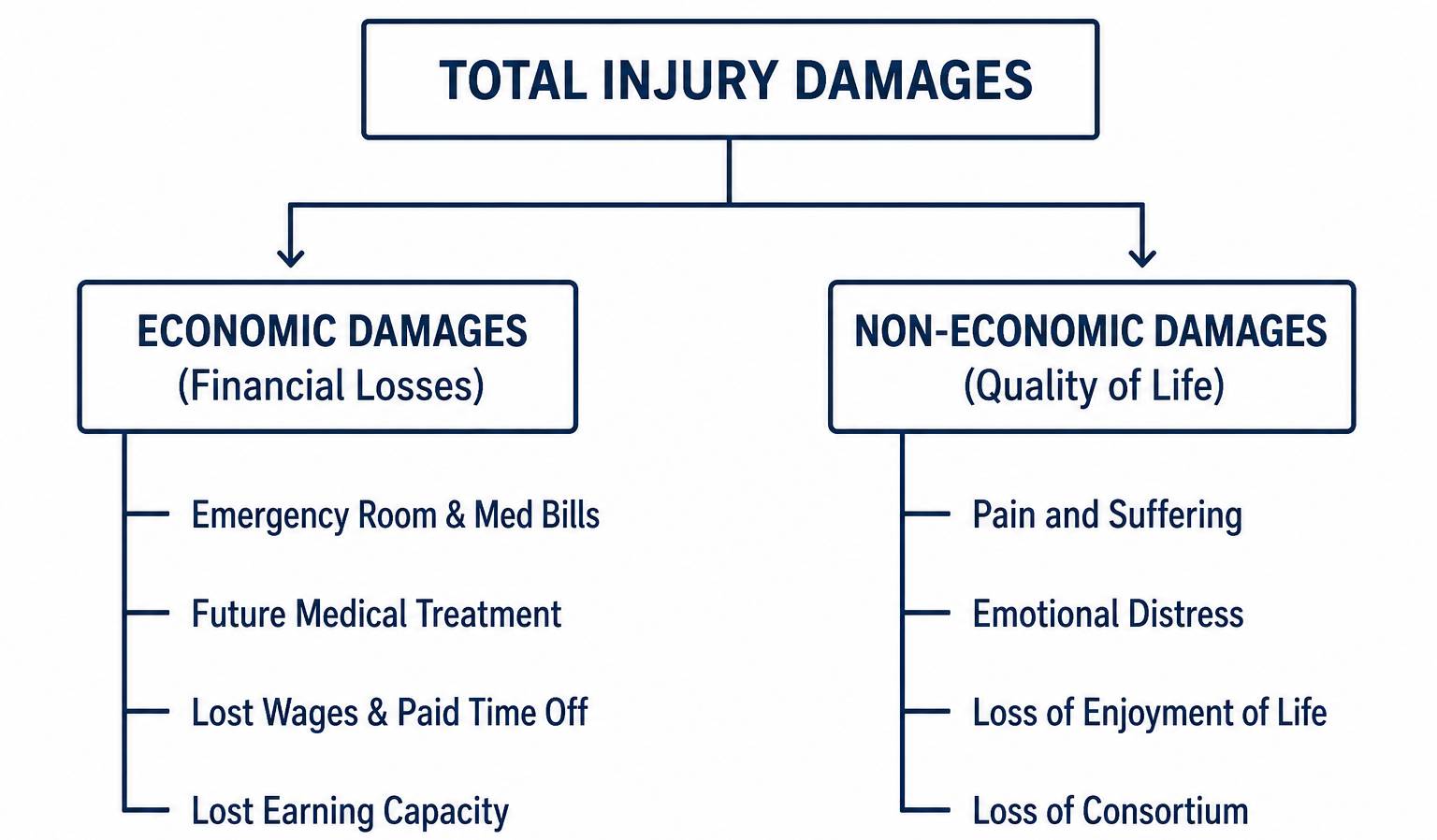

1. Economic Damages (Actual Wallet Losses)
Economic damages are designed to cover the concrete, out-of-pocket financial expenses caused by your injury. These are proven using receipts, bills, employment records, and expert financial projections:
- Immediate Medical Expenses: Complete coverage for ambulance fees, emergency room treatments, surgical procedures, hospital stays, and diagnostic imaging (like MRIs and X-rays).
- Ongoing and Future Medical Care: Financial resources for physical therapy, chiropractic treatments, mental health counseling, prescription medications, and any necessary long-term home modifications or future surgeries.
- Lost Wages: Full reimbursement for the income, bonuses, and paid time off (PTO) you lost while missing work to recover from your injuries.
- Lost Earning Capacity: If your injuries leave you with permanent limitations that prevent you from returning to your regular line of work, you can claim the long-term future income you would have earned over your lifetime.
- Vocational Rehabilitation: Compensation for skills training or job placement assistance if you must transition to a new career path due to physical restrictions.
2. Non-Economic Damages (Personal & Emotional Losses)
Non-Economic damages compensate you for the subjective, non-financial trauma caused by an accident. While these do not come with a standard receipt, they are highly significant and routinely make up a massive portion of a personal injury settlement:
- Pain and Suffering: Compensation for the actual physical pain, discomfort, and physical limitations caused by your injuries.
- Emotional Distress: Addressing the psychological impact of the trauma, including severe anxiety, depression, sleep disturbances, and post-traumatic stress disorder (PTSD).
- Loss of Enjoyment of Life: Financial recovery for being unable to participate in the hobbies, sports, family activities, or daily pastimes that you loved before you were hurt.
- Loss of Consortium: Compensation paid to close family members (such as a spouse) for the profound loss of affection, companionship, comfort, and marital support caused by your severe injuries.

Quick Reference: How Hawaii Laws Impact Your Financial Recovery
| Hawaii Legal Rule | Statutory Reference | Direct Impact on Your Settlement Payout |
|---|---|---|
|
No-Fault Medical Cap
|
Haw. Rev. Stat. § 431:10C-306 | In auto accidents, your own PIP coverage pays the first $10,000 of medical bills. You can only pursue a liability claim for additional damages once you clear this medical threshold. |
|
Comparative Fault
|
Haw. Rev. Stat. § 663-31 | Hawaii utilizes a 51% modified comparative negligence standard. You can recover damages as long as you are 50% or less at fault, but your payout is reduced by your share of blame. |
|
Non-Economic Cap
|
Haw. Rev. Stat. § 663-8.7 | Hawaii caps pain and suffering damages at $375,000 for certain general tort claims, though there are key legal exceptions depending on the severity and nature of the case. |
|
Punitive Damages
|
Hawaii Case Law Standards | If an injury is caused by malicious, intentional, or incredibly reckless conduct (like a drunk driving crash), you can seek punitive damages designed to punish the offender. |

Why Do I Need a Lawyer to Maximize My Compensation?
While you retain the absolute legal right to handle an insurance claim or injury lawsuit on your own, statistics show you are far less likely to maximize your financial recovery without an attorney.
Insurance companies operate as multi-billion dollar, for-profit corporations. Their ultimate goal is to protect their financial bottom line, which they achieve by minimizing payouts or denying valid claims entirely. They routinely use aggressive tactics—such as offering a quick, minor settlement check immediately after an accident before you know if you need surgery, or twisting your words during a recorded statement to shift the blame to you.
Hiring a dedicated, local team like Rosenberg Hoffman levels the playing field. We handle all negotiations, accurately calculate your future medical needs, counter corporate insurance tactics, and prepare your case thoroughly for trial, giving you the best possible chance to secure the highest settlement or verdict possible.
Frequently Asked Questions About Hawaii Injury Valuation
Q: Can I use an online settlement calculator to see what my Hawaii case is worth?
A: No. Online personal injury calculators are highly inaccurate marketing tools that cannot account for the unique variables of Hawaii law. They cannot calculate how the 51% modified comparative negligence rule applies to your case, nor can they accurately evaluate local factors like Oahu medical care costs or your specific long-term earning potential. To get an accurate, honest assessment of what your claim is worth, you must sit down with an experienced attorney who can review your actual medical charts and insurance policies.
Q: How do pre-existing conditions affect my right to seek compensation?
A: Having a pre-existing medical issue (such as a prior back injury or old knee condition) does not disqualify you from recovering compensation. Under Hawaii law, a negligent driver or property owner is fully responsible for any “aggravation” of a pre-existing condition. If a crash or fall caused a stable, pain-free old injury to become painful or require surgery again, we can pursue damages for the specific additional harm caused by the accident.
Q: What happens if my medical bills exceed the at-fault driver's insurance policy limits?
A: This is a common issue on Oahu, as Hawaii’s mandatory minimum bodily injury liability limit is only $20,000 per person. If your catastrophic medical treatments exceed the negligent driver’s policy limits, our legal team explores alternative compensation paths. We investigate if the driver was operating a vehicle for work (unlocking corporate policies), look for personal assets, or help you file an Underinsured Motorist (UIM) claim through your own auto insurance policy to bridge the financial gap.
Q: How long does it typically take to receive a personal injury settlement check in Hawaii?
A: There is no universal timeline because every injury recovery tracking process is unique. A straightforward claim with clear liability might settle within a few months. However, a catastrophic case requiring extensive surgery or a disputed liability trial can take a year or longer. As a general rule, our firm will never rush to settle a claim until you have reached Maximum Medical Improvement (MMI). This ensures we know the true, definitive cost of all your future healthcare needs before signing away your rights.
Q: If I recover compensation, do I have to pay taxes on my personal injury settlement?
A: Under both federal IRS rules and Hawaii state tax laws, compensatory damages received for physical personal injuries or physical sickness are entirely tax-exempt. This means you do not owe income tax on payouts meant to cover medical bills, out-of-pocket expenses, or your physical pain and suffering. However, exceptions do apply to specific elements—such as interest added to a judgment or punitive damages awarded to punish a defendant—which may be considered taxable income.
Secure the Maximum Payout for Your Case: Schedule a Free Consultation
Do not try to negotiate with an insurance adjuster while dealing with the stress of a physical recovery. Allow our local, experienced team to protect your rights, advocate for your family, and pursue every single dollar of economic and quality-of-life compensation you are legally entitled to under Hawaii law.
Rosenberg Hoffman protects injury survivors across Oahu from our offices in downtown Honolulu and Waipahu. We handle all personal injury claims on a strict contingency-fee basis—you pay absolutely nothing upfront, and we collect zero legal fees unless we successfully win your case.