

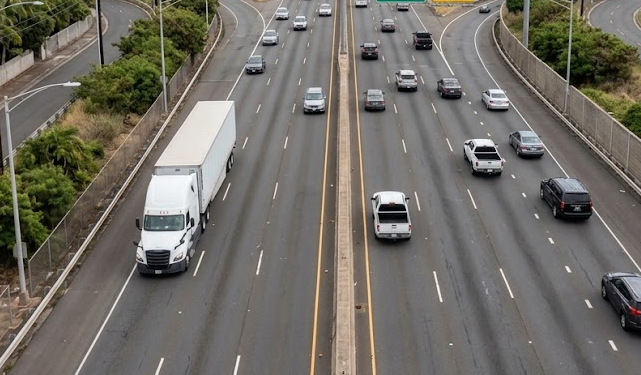
A collision with a commercial truck can leave you facing serious injuries, unexpected medical expenses, and questions about who should be held responsible.
Unlike many passenger vehicle accidents, truck collisions may involve commercial carriers, maintenance providers, cargo handlers, and specialized safety regulations. Investigating these factors can require evidence beyond a standard police report.
If you were injured in a truck accident in Hawaii, understanding the claims process can help you make informed decisions about your legal options.
At Rosenberg Hoffman, we help injured individuals evaluate negligence claims and understand their rights under Hawaii law.
Why Truck Accident Claims Require Specialized Investigation
Commercial truck accidents may involve state traffic laws, federal transportation regulations, and multiple companies responsible for different aspects of vehicle operations.
The Federal Motor Carrier Safety Administration (FMCSA) establishes safety requirements for covered commercial carriers and drivers.
Depending on the vehicle and operation, these requirements may address driver qualifications, working hours, inspections, maintenance, and cargo securement.
Driver Fatigue and Hours-of-Service Regulations
Federal hours-of-service rules generally limit covered property-carrying drivers to 11 hours of driving after 10 consecutive hours off duty, within a 14-hour driving window.
Exceptions may apply, and not every Hawaii trucking operation is subject to identical federal requirements.
Electronic logging devices may provide information about driving time and compliance.
When fatigue is suspected, an attorney may examine driver-duty records, dispatch communications, and other evidence to determine whether relevant safety requirements were followed.
Vehicle Maintenance and Cargo Safety
Brake problems, tire failures, defective equipment, and improperly secured cargo may contribute to commercial truck collisions.
Investigating these issues can involve reviewing inspection reports, repair histories, loading documents, and available vehicle data.
The purpose is to determine whether a preventable safety failure contributed to the accident and identify the party responsible.
Potentially Liable Parties in Hawaii Truck Accidents
A truck collision does not automatically create liability for every company associated with the vehicle.
Responsibility depends on each party’s conduct, legal duties, and connection to the accident.
| Potentially Responsible Party | Possible Basis for Liability |
|---|---|
| Truck driver | Distracted driving, speeding, impairment, or other negligent conduct |
| Trucking company | Negligent hiring, training, supervision, or vehicle operations |
| Maintenance provider | Negligent inspection or repair contributing to mechanical failure |
| Cargo loading company | Improper loading or cargo securement |
| Vehicle or component manufacturer | Qualifying product defects that contributed to the collision |
For example, a trucking company may face liability when its employee negligently causes a collision while performing work duties.
A separate maintenance contractor may also be investigated if evidence suggests defective repairs contributed to the crash.
Identifying all potentially responsible parties can help clarify available insurance coverage and the evidence needed to support a claim.
Legal Fees for Hawaii Truck Accident Representation
The cost of hiring an attorney is an important consideration, particularly when an accident has already affected your income and finances.
Many personal injury attorneys use contingency fee agreements, under which attorney fees are generally calculated as an agreed percentage of a financial recovery.
However, there is no universal contingency fee percentage that applies to every Hawaii truck accident case.
The agreement should explain how fees are calculated and how litigation expenses are handled.
Understanding Attorney Fees and Case Expenses
| Cost Category | What to Clarify |
|---|---|
| Attorney fees | Percentage charged and when it applies |
| Investigation expenses | Costs of obtaining records and investigating the collision |
| Expert witnesses | Responsibility for accident reconstruction or medical expert fees |
| Court costs | Filing fees, depositions, and other litigation expenses |
| Unsuccessful claims | Whether any expenses remain payable without a recovery |
Before signing an agreement, ask for a clear explanation of fees, potential expenses, and payment obligations.
Do not assume that every contingency agreement eliminates all possible costs if a claim is unsuccessful.
Choosing a Truck Accident Attorney in Hawaii
Commercial truck cases may require experience with complex evidence, insurance issues, and multiple defendants.
When evaluating legal representation, consider whether the attorney can explain the investigation process and identify the records that may be important.
Useful questions include:
- Experience: Have you handled claims involving commercial trucks and multiple potentially responsible parties?
- Evidence: How would you seek driver logs, maintenance records, and relevant vehicle data?
- Resources: Can the case support accident reconstruction or other expert analysis if necessary?
- Communication: Who will provide updates and answer questions about the case?
- Fees: How are attorney fees and litigation expenses calculated?
An attorney should be able to explain the potential strengths and challenges of a claim without guaranteeing a settlement amount or outcome.
The Truck Accident Claims Process in Hawaii
Every accident claim develops differently depending on the injuries, available evidence, insurance coverage, and disputed legal issues.
The process generally involves several stages.
1. Initial Case Evaluation
An attorney reviews the collision circumstances, medical treatment, available documentation, and potentially responsible parties.
2. Investigation and Evidence Preservation
Relevant evidence may include driver-duty records, maintenance documents, cargo records, vehicle data, photographs, and witness statements.
For covered carriers, FMCSA rules generally require electronic records of duty status and supporting documents to be retained for six months.
However, other electronic information may have different retention practices. Prompt preservation requests can help protect relevant evidence.
3. Evaluation of Injuries and Losses
Medical records, employment documentation, and other evidence help establish the accident’s effects.
Future treatment needs may require additional medical evaluation.
4. Settlement Negotiations or Litigation
An attorney may negotiate with the responsible parties’ insurers after evaluating liability and damages.
If an appropriate settlement cannot be reached, filing a lawsuit may be necessary.
The length of the process depends on the circumstances. No fixed settlement or trial timeline applies to every case.
Compensation Available After a Hawaii Truck Accident
Depending on the facts and applicable law, a successful personal injury claim may provide compensation for several categories of losses.
These may include medical expenses, rehabilitation, lost income, reduced earning capacity, pain and suffering, and qualifying property damage.
Hawaii’s modified comparative negligence rule under HRS §663-31 may also affect recovery.
If an injured person shares responsibility for a collision, damages may be reduced proportionally. Recovery may be barred when that person’s negligence exceeds the combined negligence of the parties against whom recovery is sought.
The amount recoverable depends on the evidence and applicable legal requirements. Commercial insurance coverage does not guarantee a particular settlement.
For additional information, see our guide to compensation in Hawaii personal injury cases.
Steps to Take After a Truck Accident in Hawaii
If you were involved in a collision with a commercial truck, prioritize your safety and medical needs.
- Seek medical attention. Obtain emergency care when needed and follow your healthcare provider’s recommendations.
- Report the collision. Contact law enforcement when appropriate and request information about obtaining the accident report.
- Document the scene. When safe, photograph the vehicles, road conditions, damage, and relevant markings on the truck.
- Preserve records. Keep medical bills, witness information, insurance correspondence, and documentation of missed work.
- Review settlement documents carefully. Understand the effect of any proposed release before resolving your claim.
If possible, record the trucking company’s name and identifying information displayed on the vehicle.
Avoid attempting to obtain restricted company records yourself. An attorney can explain lawful evidence-preservation procedures.
Filing Deadlines for Hawaii Truck Accident Lawsuits
Hawaii generally provides a two-year limitations period for personal injury actions under HRS §657-7.
However, motor vehicle accident claims are subject to specific provisions under HRS §431:10C-315.
Depending on the claim and qualifying benefit payments, the applicable deadline may extend beyond two years from the accident date.
Other circumstances may involve additional requirements or exceptions.
Prompt legal review is important because critical evidence can become unavailable before a filing deadline approaches.
Legal note: Filing deadlines depend on the claim, applicable benefits, and statutory exceptions. Individual circumstances require legal evaluation.
Discuss Your Hawaii Truck Accident Claim With Rosenberg Hoffman
A commercial truck collision can leave you facing serious injuries, financial losses, and complicated questions about liability and insurance coverage.
At Rosenberg Hoffman, we help injured individuals understand their legal options and pursue claims involving negligent drivers, trucking companies, and other potentially responsible parties.
Learn more about how our Hawaii truck accident lawyers can help you evaluate your claim, investigate liability, and pursue available compensation under Hawaii law.
Call 808-470-4819 or visit our contact page to schedule a free, 100% confidential consultation today.
Legal disclaimer: This article provides general information about Hawaii truck accident and personal injury law, including applicable commercial trucking regulations. It does not constitute legal advice. Claim eligibility, liability, damages, insurance coverage, and filing deadlines depend on the circumstances of each case.
