

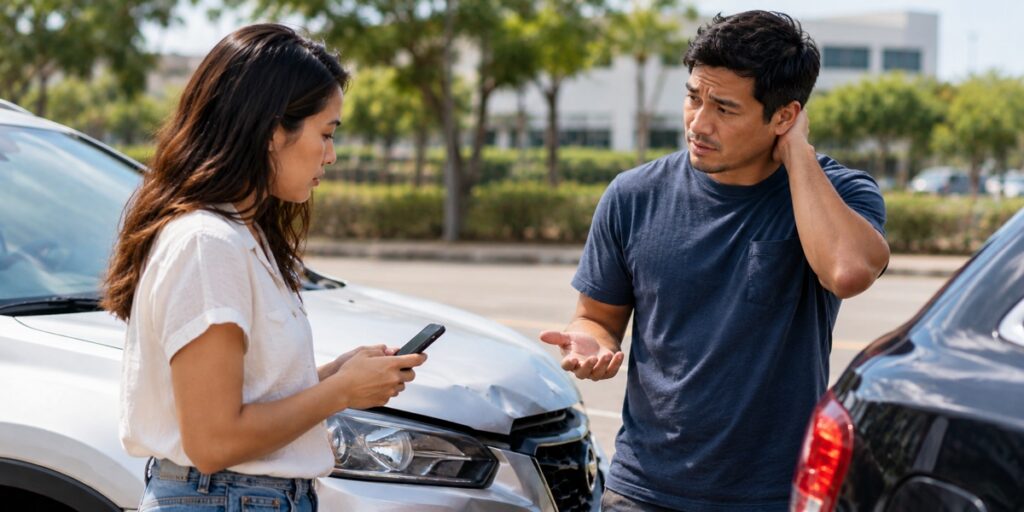
The driver who hit you stopped, exchanged information, and then told you they did not have car insurance. Now you’re dealing with injuries, medical bills, and an unsettling question: Who is going to pay for the damage this accident caused?
When an at-fault driver has no insurance, recovering compensation can be more complicated. There may be no liability insurance company available to pay a claim on that driver’s behalf.
But that does not necessarily mean you have no options.
Hawaii’s no-fault insurance system may provide certain benefits through your own policy. You may also have uninsured motorist coverage or other applicable insurance. In some circumstances, pursuing a claim against the driver personally may be possible.
At Rosenberg Hoffman, we help people injured in Hawaii car accidents understand their rights and options. Here’s what matters when the driver responsible for your injuries has no insurance.
Your Options for Compensation After an Uninsured-Driver Accident
When an at-fault driver has no applicable liability insurance, identifying other potential sources of compensation becomes especially important.
Hawaii’s insurance system may provide some protection, but the coverage available depends on your policy and the circumstances of the accident.
| Potential source | How it may help | Important limitation |
|---|---|---|
| Personal injury protection (PIP) | Provides benefits for certain covered accident-related expenses regardless of fault | Subject to applicable law, policy terms, and limits |
| Uninsured motorist (UM) coverage | May compensate for certain injury-related losses caused by an uninsured driver | Depends on whether you have applicable UM coverage and its limits |
| Other applicable insurance | Another policy may apply based on the driver, vehicle, or accident circumstances | Coverage must be investigated and confirmed |
| Claim against the uninsured driver | May provide a legal path to compensation when permitted under Hawaii law | A judgment does not guarantee that the driver can pay |
Personal Injury Protection (PIP)
Hawaii requires no-fault automobile insurance, including personal injury protection (PIP) coverage.
Under Hawaii’s no-fault automobile insurance requirements, PIP generally provides benefits for certain covered accident-related expenses regardless of who caused the crash. This means you may have access to PIP benefits even when the at-fault driver has no insurance.
However, PIP is subject to coverage limits and applicable policy terms. It does not necessarily compensate you for every loss resulting from the accident, making it important to understand what other coverage may be available.
Uninsured Motorist (UM) Coverage
Uninsured motorist (UM) coverage may provide another source of compensation when a driver without applicable liability insurance causes a collision.
Under Hawaii’s uninsured motorist coverage requirements, insurers generally must offer UM coverage, although a named insured may reject it in writing.
If you purchased UM coverage, it may help compensate you for certain injury-related losses caused by the uninsured driver, subject to your policy terms and applicable Hawaii law.
Review your insurance policy and declarations page to determine whether you have UM coverage, what limits apply, and which losses may be covered.
Confirming Whether the Driver Is Uninsured
Before assuming there is no applicable liability insurance, confirm the driver’s coverage status.
A driver may be unable to produce proof of insurance at the scene or may be uncertain whether the vehicle is covered under another policy.
If it is safe to do so, collect the driver’s name, contact information, license plate number, and vehicle details. Preserve any insurance information they provide, even if they believe the policy has expired.
A police report may also contain information useful in identifying the driver and investigating available coverage.
A driver who cannot show proof of insurance is not necessarily a driver for whom no insurance coverage exists.
Confirming the coverage situation can help you identify the appropriate next steps.
Building a Claim Against an Uninsured Driver
The other driver’s lack of insurance does not automatically establish responsibility for the crash or the amount of compensation you may be entitled to pursue.
You still need evidence showing how the collision occurred, what injuries resulted, and how those injuries affected you.
This information may be important when making a claim under your own uninsured motorist coverage or considering legal action against the driver.
Evidence of Fault
Photographs of vehicle damage, road conditions, traffic signs, and the accident scene may help establish how the collision occurred.
Witness contact information, police reports, and available video footage may also help clarify responsibility.
Even if the driver admits fault at the scene, preserve the available evidence. Fault may later be disputed.
Medical Records and Injury Documentation
Medical records help establish the nature of your injuries and their connection to the accident.
Seek appropriate medical care if you are injured or experiencing symptoms. Describe your condition accurately to your medical providers and follow their treatment recommendations.
Keep records of appointments, treatment, prescriptions, and related expenses.
If your injuries interfere with work or daily activities, discuss those limitations with your treating provider so your medical record accurately reflects your condition.
Lost Income and Other Financial Losses
If the accident affects your ability to work, keep relevant pay records, employer communications, and documentation of missed work.
Save receipts and invoices for other accident-related expenses.
Not every expense will necessarily be recoverable, but organized documentation helps establish the financial impact of the collision.
Can You Sue an Uninsured Driver in Hawaii?
Possibly. However, whether you can bring a lawsuit and whether you can collect money from the driver are separate questions.
Hawaii’s no-fault system restricts certain lawsuits arising from motor vehicle accidents. Whether you can pursue an injury claim against the at-fault driver depends on the circumstances and applicable statutory exceptions.
If a claim is legally available, the driver’s financial situation also matters.
Someone without car insurance may have limited assets or income. Even if you obtain a judgment, collecting the amount awarded may be difficult.
A judgment establishes a legal obligation, but it does not guarantee payment.
That is why evaluating your insurance coverage is important before deciding whether pursuing the uninsured driver personally is practical.
An attorney can help assess both the legal basis for a claim and the available paths to compensation.
When Your Insurance Company Disputes the Claim
If you have uninsured motorist coverage, your insurer may investigate the collision, confirm the other driver’s insurance status, and evaluate your injuries and losses.
Requests for medical records, accident reports, and other documents can be part of the ordinary claims process.
However, disagreements may arise over fault, coverage, whether an injury resulted from the collision, or the value of your losses.
If your insurer questions or denies part of your claim, ask for a clear explanation of the issue and any additional information needed. Keep copies of correspondence and review the relevant policy provisions.
You should also understand what a proposed settlement would resolve before accepting it. A settlement may require signing a release that prevents you from pursuing additional compensation for the claims covered by the agreement.
Insurance policies and legal claims may also involve different notice requirements and deadlines. Do not assume that one deadline applies to every possible claim.
For situations involving a driver who leaves the scene and cannot be identified, see our separate article on uninsured motorist claims on Oahu after a hit-and-run crash.
Discuss Your Uninsured-Driver Accident With Rosenberg Hoffman
Being hit by a driver without insurance can leave you facing expenses and uncertainty about how to recover compensation.
The important questions are which insurance policies may apply, what evidence supports your claim, and whether pursuing the driver personally is legally and practically appropriate.
Legal guidance may be especially useful if you suffered significant injuries, fault is disputed, your insurer questions coverage, or you are unsure whether to accept a settlement.
At Rosenberg Hoffman, we represent people injured in Hawaii car accidents. We offer direct access to our attorneys so you can discuss your situation and receive straightforward guidance about your options.
We offer free consultations to discuss potential personal injury claims.
Contact Us or call 808-470-4819 to tell us what happened and learn about your options.
This article provides general information about Hawaii law and is not legal advice. Insurance coverage, legal rights, and deadlines depend on the facts of each case, applicable policies, and current law.
