

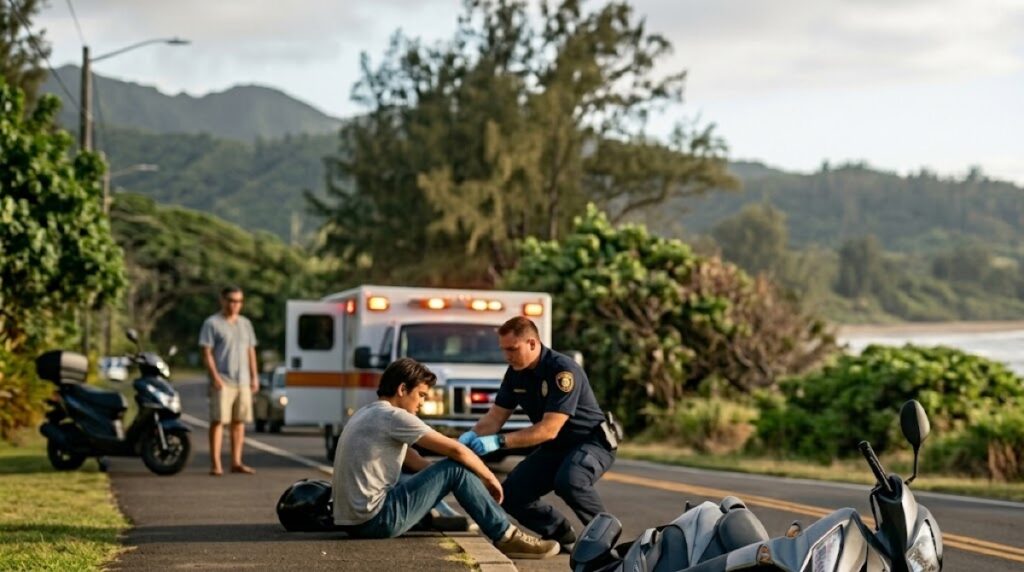
A moped accident can leave you facing emergency room bills, follow-up appointments, and missed work before you know who was responsible for the crash. If you were riding a moped when a car hit you, you may also discover that the insurance rules are different from those that apply to ordinary car accidents.
Who pays your medical bills depends on the insurance policies involved, how the crash happened, and whether another party may be legally responsible. Health insurance may help cover treatment. Other available coverage or a claim against an at-fault driver may also be relevant. But you should not assume that Hawaii’s no-fault car insurance system automatically pays a moped rider’s medical expenses.
Understanding these differences can help you make decisions about treatment, insurance claims, and your financial recovery.
Hawaii’s No-Fault Insurance Rules for Moped Riders
Hawaii has a no-fault automobile insurance system. For covered automobile accidents, Personal Injury Protection (PIP) benefits can pay certain accident-related expenses without first establishing who caused the crash.
Mopeds are treated differently from ordinary passenger cars. A moped rider should not assume that the PIP benefits associated with a standard automobile policy will automatically apply.
The answer depends on the vehicle’s legal classification, the applicable policies, and the circumstances of the accident. Before relying on any particular benefit, review the actual coverage available to you.
For background on Hawaii’s automobile insurance system, see the Hawaii Insurance Division’s motor vehicle insurance information.
Insurance Options for Moped Accident Medical Expenses
There may be more than one potential source of payment after a moped crash. Some coverage can help with treatment expenses as they arise, while other claims may provide reimbursement or compensation later.
| Potential payment source | How it may help | What to check |
|---|---|---|
| Health insurance | May cover emergency treatment, appointments, imaging, surgery, or rehabilitation | Deductibles, network rules, exclusions, and possible reimbursement obligations |
| Optional medical coverage | May provide benefits if an applicable policy includes medical expense coverage | Whether the coverage applies to the moped, rider, and accident |
| At-fault driver’s liability insurance | May provide compensation for medical expenses when the driver is legally responsible | Fault, policy limits, evidence, and claim resolution |
| Uninsured or underinsured motorist coverage | May be relevant if the responsible driver has no insurance or insufficient coverage | Policy language, exclusions, and whether the rider qualifies for benefits |
| A claim involving another responsible party | May be possible if a vehicle defect, negligent maintenance, or another party’s conduct contributed to the crash | Evidence connecting that party’s conduct to the injury |
These options are not interchangeable. For example, a health insurer may process an eligible hospital bill before a liability claim is resolved. A claim against a negligent driver generally requires evidence of responsibility and damages.
Using Health Insurance for Accident-Related Treatment
Health insurance may be an important source of coverage for immediate medical care.
If you have health insurance, contact your plan to understand how accident-related treatment is handled. Ask whether you need referrals or authorizations for follow-up care and whether particular providers are in your network.
You should also ask whether the plan may seek reimbursement if you later receive money from an injury claim. This is sometimes called subrogation or a reimbursement claim. The applicable rules depend on the plan and the circumstances.
Do not assume that using health insurance prevents you from pursuing a separate claim against someone responsible for the accident.
When the At-Fault Driver’s Insurance May Pay
If another driver negligently caused the crash, you may have a claim for medical expenses and other resulting losses.
For example, if a driver turned across your path without yielding and caused a collision, that driver’s liability insurance may be relevant. But the insurer may investigate fault, question whether particular treatment was related to the accident, or dispute the amount claimed.
A liability claim is also different from having an insurer immediately pay each hospital bill. You may need to address medical expenses while the claim is being evaluated.
For a broader explanation of injury claims involving motor vehicles, see our car accident representation page.
What Happens if the Other Driver Has No Insurance?
An uninsured driver can make the financial consequences of a moped accident more difficult.
You may still have options, but they depend on the facts and available insurance. Uninsured motorist (UM) or underinsured motorist (UIM) coverage may be worth reviewing, particularly if you or a household member has an applicable policy.
Under Hawaii’s uninsured motorist coverage statute, insurers generally must offer UM coverage for applicable motor vehicle policies, although a named insured may reject it in writing. That does not mean every UM policy covers every moped accident.
Eligibility can depend on policy terms, the rider’s insured status, and the vehicle involved.
If you were injured by an uninsured driver, preserve the driver’s information and any insurance correspondence. Reviewing the relevant policies can help determine whether a claim is available.
Medical Coverage Issues With Rental Mopeds
If you rented the moped, keep the rental agreement and any paperwork describing insurance or optional protections.
A rental agreement may explain responsibility for damage to the moped without necessarily providing medical coverage for the rider. Those are separate questions.
Review:
- Whether you purchased any optional protection.
- What the rental agreement says about insurance.
- Whether you received separate coverage documents.
- Whether the moped had a mechanical problem that contributed to the crash.
Do not assume that a rental company’s insurance will pay your hospital bills, or that signing a waiver automatically eliminates every potential claim.
If you were visiting Hawaii when the accident happened, your existing health insurance and other policies may also need to be reviewed.
Managing Medical Bills While Your Claim Is Pending
Medical bills often arrive before an injury claim is resolved. A practical first step is to organize them and identify which insurer, if any, should receive each bill.
- Get the medical care you need. Follow your treating provider’s advice rather than delaying care solely because insurance responsibility is uncertain.
- Tell providers that the injuries resulted from a moped accident. Give accurate insurance information and ask how bills will be submitted.
- Contact your health insurer. Confirm how accident-related treatment is processed and what documentation is required.
- Keep every bill and insurance notice. Save explanations of benefits, payment receipts, denial letters, and records of out-of-pocket expenses.
- Document lost income and ongoing treatment. These records may matter if you later pursue compensation.
- Ask questions before signing a settlement release. A final settlement may affect your ability to seek additional compensation for the same injuries.
If a claim is denied, request the reason in writing. A denial may involve a policy exclusion, missing documentation, or a dispute about whether the treatment was covered.
You can also ask medical providers about billing arrangements or available financial assistance while insurance questions are being resolved. Availability varies by provider.
Recovering Medical Expenses Through an Injury Claim
Potentially. If another party is legally responsible for the accident, medical expenses may form part of an injury claim.
That can include eligible past expenses and, when supported by medical evidence, reasonably anticipated future care. The amount recoverable depends on the facts, applicable law, insurance coverage, and any reimbursement obligations.
Keep records of expenses that are easy to overlook, including prescriptions, therapy visits, medical equipment, and travel directly related to treatment.
Medical expenses are only one possible part of an injury claim. Depending on the circumstances, other losses may also be relevant, such as lost earnings or pain and suffering.
Hawaii’s comparative negligence rules may affect recovery if more than one person contributed to the crash. An insurer’s initial fault assessment does not necessarily settle that question.
When Legal Guidance Can Help
You may want legal guidance when medical bills are substantial, fault is disputed, treatment is ongoing, or insurers disagree about coverage.
A consultation can help you understand questions such as:
- Which policies might apply to your injuries?
- Is another driver or party potentially responsible?
- How should you handle a disputed medical bill or insurance denial?
- Could a settlement affect future medical expenses?
- Are there claim deadlines or notice requirements that need immediate attention?
Under Hawaii Revised Statutes § 657-7, many personal injury lawsuits are subject to a two-year limitations period. Different rules or notice requirements may apply to particular claims, including those involving government entities. Insurance policies can also have separate reporting requirements.
At Rosenberg Hoffman, we offer free consultations, and our clients have direct access to an attorney. We handle many personal injury matters on a contingency-fee basis, with the terms and responsibility for case costs explained in the applicable agreement.
Discuss Your Moped Accident With Rosenberg Hoffman
You should not have to guess which insurance policy may apply while you are dealing with an injury.
If you are dealing with medical bills, disputed fault, or insurance questions after a moped crash, learn more about how we help people injured in moped, bicycle, and pedestrian accidents in Hawaii.
Contact Us or call 808-470-4819 to request a free consultation.
This article provides general information, not legal advice. Insurance coverage and legal rights depend on the facts, applicable policies, and current law. Contacting our firm does not, by itself, establish an attorney-client relationship.
