

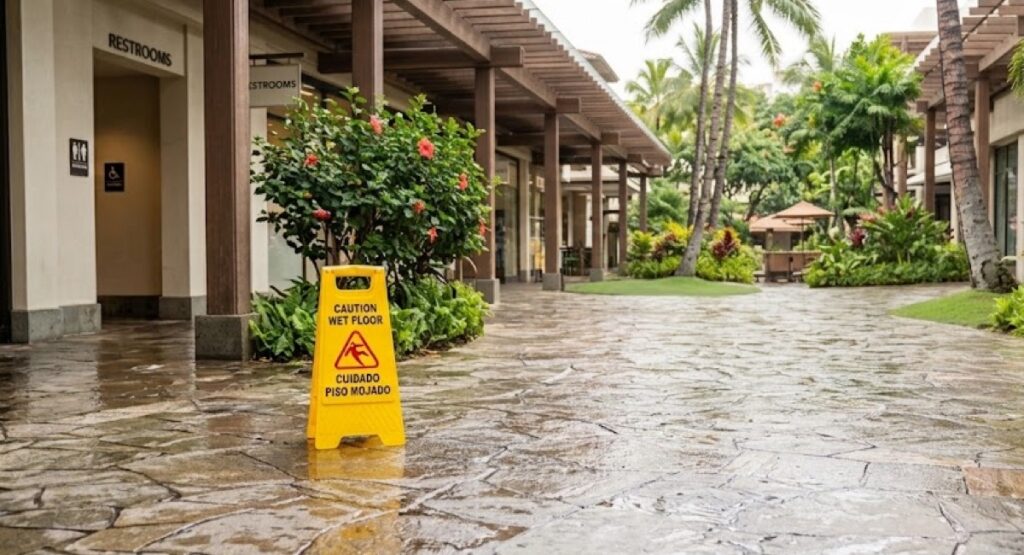
You slip on a wet floor at a Hawaii hotel, trip over uneven pavement outside a store, or fall on a poorly maintained staircase. You know where you fell and how you were injured. But does that mean the property owner is responsible?
Not necessarily. A slip and fall accident does not automatically establish negligence. The important questions are whether an unsafe condition existed, who was responsible for addressing it, and whether reasonable steps were taken to prevent foreseeable harm.
Understanding these questions can help you evaluate what happened before accepting an insurance company’s explanation or assuming you have no claim.
When Property Owners May Be Liable for a Fall
Property owners and occupiers generally have a duty to use reasonable care for the safety of people reasonably expected to be on their premises. However, that duty does not make them responsible for every accident.
A person can fall without anyone having acted negligently. For example, a visitor might lose their balance on a properly maintained surface. By contrast, a fall involving a damaged stair, an unattended spill, or inadequate lighting may raise questions about whether reasonable precautions were taken.
In a Hawaii premises liability claim, the analysis generally considers whether:
- An unreasonably dangerous condition existed.
- The responsible party knew or reasonably should have known about it, where notice is required.
- Reasonable steps were taken to address the danger or provide an adequate warning.
- The condition contributed to the injury.
- The injured person suffered losses connected to the accident.
These questions come from Hawaii’s negligence framework, including decisions addressing unsafe property conditions. The Hawaii Supreme Court’s decision in Winfrey v. GGP Ala Moana LLC discusses the duty of reasonable care owed to people whose presence on a property can reasonably be anticipated. The circumstances of the individual accident determine how these principles apply.
Unsafe Property Conditions That May Lead to Liability
Not every uneven surface or wet area creates legal responsibility. The question is whether the condition presented an unreasonable risk under the circumstances.
Consider a supermarket entrance during heavy rain. Water may be tracked inside by customers. The presence of moisture alone does not establish negligence. Relevant questions include whether the entrance had appropriate mats, whether staff monitored the area, and whether the condition had been present long enough to be addressed.
Other situations may involve a different kind of hazard.
| Potential hazard | Questions that may matter |
|---|---|
| Wet flooring | Where did the water come from, and were reasonable precautions taken? |
| Broken stairs or handrails | Was the defect known, reported, or reasonably discoverable? |
| Uneven walkways | How significant was the condition, and was it foreseeable that someone could trip? |
| Poor lighting | Did the lighting make an existing hazard difficult to identify? |
| Loose floor coverings | Could reasonable inspection or maintenance have revealed the problem? |
This distinction matters because an injury, even a serious one, does not by itself prove that someone failed to use reasonable care.
How Property Control Affects Legal Responsibility
The person or business whose name appears on a building is not always the only party relevant to a claim.
A hotel might own its premises but contract with another company for certain maintenance work. A shopping center may have common areas maintained separately from individual stores. A landlord and tenant may have different responsibilities under their agreement and the circumstances.
That does not mean every contractor or property owner is automatically liable. It means determining responsibility may require examining who controlled the area and who had authority or responsibility to address the particular hazard.
Questions That Can Help Identify the Responsible Party
If you are unsure who maintained the location, start with practical details:
- Did the fall occur inside a business or in a shared walkway?
- Was the condition associated with cleaning, construction, or maintenance?
- Who received complaints about the area?
- Was the hazard in a space used by several businesses or residents?
- Did employees or maintenance personnel respond after the accident?
These facts may help identify the people or organizations whose conduct needs to be examined. A lawyer can evaluate whether the available information supports a claim against one or more parties.
Why It Matters Whether Someone Knew About the Hazard
One of the central questions in many Hawaii slip and fall cases is notice.
A business may have actual notice when an employee sees a spill or receives a complaint about a damaged step. Constructive notice can arise when a condition existed long enough that it reasonably should have been discovered through appropriate care.
For example, suppose a customer drops a drink in a store aisle, and another customer slips almost immediately. Whether the store had a reasonable opportunity to discover and address the spill could be important.
Now consider a leak that repeatedly leaves water on the same floor. Previous complaints, inspection records, or maintenance requests might tell a different story about what the business knew.
Hawaii courts have also considered how a business’s operating practices affect its responsibility for foreseeable hazards. In Gump v. Wal-Mart Stores, Inc., the Hawaii Supreme Court addressed circumstances in which a store’s mode of operation could establish constructive notice of a potential danger without proof that employees knew about the specific item that caused the fall.
The important point is that a fall’s location does not answer the notice question. The history of the condition and the response to it may be just as significant.
How Visible Hazards Affect Slip and Fall Claims
People sometimes assume that a visible hazard automatically defeats an injury claim. Hawaii law is more nuanced.
In Steigman v. Outrigger Enterprises, Inc., the Hawaii Supreme Court rejected the known-or-obvious-danger defense as an automatic bar to recovery in premises liability cases. The circumstances surrounding a visible danger may instead be considered under comparative negligence principles.
That does not mean someone can disregard an obvious risk without consequences. It means visibility alone should not be treated as the complete answer to whether a claim is possible.
Imagine a person walking through a hotel entrance where water has accumulated. Whether the condition was apparent, whether a safer route was reasonably available, and whether the property operator took appropriate precautions may all be relevant.
Each case requires consideration of the circumstances rather than a simple rule that visible hazards are always the injured person’s responsibility.
Comparative Negligence in Hawaii Slip and Fall Cases
Yes, depending on the degree of responsibility assigned and the other elements of the claim.
Under Hawaii Revised Statutes § 663-31, comparative negligence can reduce compensation when the injured person’s conduct contributed to the accident. Recovery is generally barred when that person’s negligence is greater than the negligence of the defendant or the combined negligence of the defendants against whom recovery is sought.
For example, someone might have been looking at a phone while walking near an inadequately marked hazard. Their attention could become an issue, but it would not automatically eliminate the need to examine the property’s condition and the responsible party’s conduct.
Determining comparative fault involves evaluating the evidence. Neither the property owner’s accusation nor the injured person’s initial assumption necessarily establishes the final allocation of responsibility.
Evidence That Can Help Establish Property Owner Liability
The strongest evidence often addresses the condition of the property before the fall, not just the injuries afterward.
Photographs taken soon after the accident may show a spill, damaged flooring, missing warning sign, or obstructed walkway. Wider images can also establish the surrounding layout and lighting.
Other useful records may include:
- Witness statements describing the condition before the fall
- Incident reports prepared by the property operator
- Available surveillance footage
- Earlier complaints or maintenance records, when obtainable
- Photographs of the footwear worn during the accident
- Medical records documenting the resulting injuries
Some of this information may be controlled by the business or another party. Surveillance recordings can also be overwritten through routine retention practices.
If you were injured, prioritize medical attention. When practical, preserve the information already available to you and record the location and approximate time of the incident. Do not place yourself at further risk to investigate the scene.
Legal Guidance for Hawaii Slip and Fall Claims
Consider seeking legal guidance when your injuries require significant treatment, responsibility is disputed, the property operator denies knowing about the hazard, or important evidence is not available to you.
You may also benefit from advice when several parties appear to share responsibility or when the accident occurred on government property.
A consultation can help identify which questions still need answers. It does not mean every fall will support a successful claim, and no responsible assessment should promise an outcome before the facts are understood.
At Rosenberg Hoffman, we represent people pursuing personal injury claims in Hawaii. If you were hurt in a fall and are uncertain whether unsafe property conditions contributed to your injuries, we can discuss what happened and the information you have collected. Learn more about how we assist injured individuals on our Hawaii slip and fall and premises liability claims page.
Call us at 808-470-4819 or contact our team to discuss your situation.
This article provides general information, not legal advice. Reading it or contacting our firm does not, by itself, establish an attorney-client relationship.
