

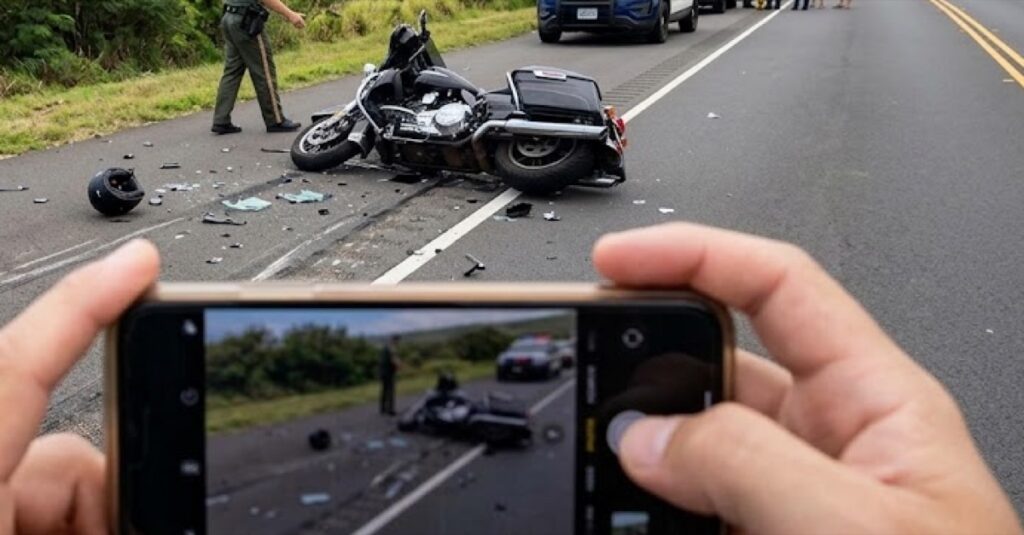
After a motorcycle crash, you may remember a car turning across your lane or changing lanes without enough room. The other driver may remember it differently. When accounts conflict, the evidence left behind can be more useful than either person’s confidence about what happened.
Evidence also matters when an insurer questions the extent of your injuries or whether particular expenses resulted from the collision. The goal is not to collect everything imaginable. It is to preserve information that can help explain the crash and document its consequences.
If you were injured, your medical needs come first. You can still take steps afterward, or ask someone you trust to help, to protect records that might otherwise disappear.
Why Evidence Matters When Fault Is Disputed
A claim may involve several separate questions: How did the vehicles come together? Did a driver fail to yield or leave enough space? Did road conditions play a role? What injuries and financial losses followed?
Different evidence answers different questions. A photograph may show where the motorcycle came to rest but not prove the speed of either vehicle. A witness may describe a turning car but know nothing about the rider’s medical condition. Medical records can document treatment without establishing who caused the crash.
That distinction matters. Strong documentation is usually a collection of consistent, relevant details rather than one supposedly decisive item.
Photos and Video That Can Help Reconstruct the Crash
If it is safe to do so, photographs taken before the scene changes can preserve details that are difficult to recreate later. Useful subjects include:
| Evidence | What It May Show | Why It Matters |
|---|---|---|
| Vehicle positions | Where the motorcycle and other vehicles stopped | Helps establish the scene before vehicles are moved |
| Motorcycle and vehicle damage | Areas of impact and visible damage | May help evaluate how the vehicles made contact |
| Skid marks and road debris | Physical traces left by the collision | May provide context about vehicle movements |
| Traffic signs and lane markings | Road rules and lane configuration | Helps assess right-of-way disputes |
| Road conditions | Potholes, loose gravel, or other hazards | May identify conditions that contributed to the crash |
| Dashcam or surveillance footage | Vehicle movements before or during impact | May help clarify conflicting accounts |
Why Timing Matters
Some camera systems routinely overwrite older recordings. Vehicles may be repaired and roadway debris removed. If you notice a camera nearby, record its location and the approximate time of the crash. Do not assume footage will remain available indefinitely.
An attorney may be able to help identify relevant records and determine appropriate ways to request their preservation. Availability and access depend on the source and circumstances.
Why Independent Witnesses Matter
A witness who was not involved in the collision may help clarify disputed events. Someone at a crosswalk might have seen a vehicle turn into the rider’s path. Another driver might remember whether a lane change occurred before the impact.
If you can safely speak with witnesses, ask for their names and contact details. Note where they were positioned and what they say they observed. Avoid suggesting answers or asking them to take sides. Their own recollection is more useful than a version shaped by someone else’s account.
Not every witness will have seen the entire crash. One person may have heard the impact but not seen the approach. Another may have observed the traffic signal but not the vehicles’ positions. Those limits should be understood rather than ignored.
What a Police Report Can and Cannot Establish
A police report can provide an important starting point. It may identify the people and vehicles involved, record the reported location, and list witnesses or observations made by responding officers.
However, an officer often arrives after the vehicles have stopped or been moved. Parts of the report may reflect statements from the drivers rather than firsthand observations. A report can contain useful evidence without resolving every factual disagreement.
Request a copy when it becomes available and review it carefully. If your collision occurred on Oahu, the Honolulu Police Department’s police reports page explains how to request a motor vehicle collision report. If you notice a possible error, keep the documents or photographs that support your account. Do not alter the report yourself or assume that an apparent mistake automatically determines the claim’s outcome.
What Motorcycle Damage and Riding Gear May Reveal
A motorcycle provides little separation between the rider and the point of impact. Damage to the bike and the rider’s equipment can therefore be relevant to understanding the collision, although it should not be interpreted without context.
For example, the location of damage may help investigators evaluate where contact occurred. Photographs of a broken mirror, bent handlebar, scraped fairing, or damaged wheel can preserve details before repairs begin.
A helmet, jacket, boots, and gloves may also show signs of impact or abrasion. Photograph their condition and, when practical, retain them until you know whether they may be needed. Do not continue using protective equipment that may no longer be safe.
Keep repair estimates, towing invoices, and communications about the motorcycle’s condition. These records may help document property damage and establish what happened to the bike after the crash.
Medical Records and Documentation of Your Losses
Crash evidence is not limited to the roadway. Medical records help show what injuries were evaluated, when symptoms were reported, and what treatment was recommended.
Seek appropriate medical attention, especially if you have significant pain, head injury symptoms, or difficulty moving normally. Tell your healthcare providers what you are experiencing accurately. If symptoms change, report those changes rather than assuming they are unimportant.
Keep copies of appointment information, treatment instructions, bills, and receipts. If your injuries affect work, preserve relevant employment records and documentation of missed time or reduced earnings. You can also maintain a dated account of activities you cannot perform as usual.
These records do not automatically establish that every expense is recoverable. They help explain the claimed effects of the accident so those losses can be evaluated under the applicable law.
How Evidence Can Address Allegations Against the Rider
After a collision, the other driver or an insurer may allege that the motorcyclist was speeding, following too closely, or traveling where the driver could not see them. Such allegations deserve careful examination, not an automatic acceptance or rejection.
Consider a driver who says a rider appeared suddenly before a left turn. Intersection photographs, witness accounts, available video, and the vehicles’ damage may help assess whether that description fits the available facts.
Hawaii’s comparative negligence rules can affect recovery when an injured person shares responsibility for an accident. But the focus here is practical: preserve evidence that may help establish what each person actually did. Fault is evaluated from the circumstances, not simply from the size of the vehicles or assumptions about motorcyclists.
When a Motorcycle Accident Requires Further Investigation
Some collisions leave obvious physical evidence and consistent witness accounts. Others raise unanswered questions. Further investigation may be especially useful when the vehicles were moved before anyone documented their positions, the drivers offer sharply different accounts, or a third party may have relevant information.
In more complex situations, an investigation might examine roadway measurements, additional recordings, vehicle condition, or other available records. Whether that work is necessary depends on what is genuinely disputed and what evidence still exists.
The purpose is not to make every case complicated. It is to identify the unanswered questions that could materially affect the claim.
Common Mistakes That Can Weaken Accident Evidence
Evidence can become less useful when it is lost, altered, or separated from its original context. After a motorcycle accident, avoid these common mistakes:
- Deleting original photos or videos: Keep the original files whenever possible instead of relying only on cropped, edited, or compressed versions.
- Discarding damaged motorcycle gear: Photograph your helmet, jacket, gloves, and other damaged equipment before deciding what to do with them. These items may contain relevant evidence.
- Losing important documents: Save insurance correspondence, medical records, repair estimates, receipts, and other documents related to the collision.
- Guessing about accident details: If you cannot remember a specific detail, avoid making assumptions. An accurate statement about what you do and do not recall is more useful than an unsupported estimate.
- Posting too much on social media: Be thoughtful about sharing details of the crash, your injuries, or your recovery. These statements may later be compared with other evidence.
- Waiting too long to preserve evidence: Camera recordings may be overwritten, witnesses may become harder to contact, and physical evidence may disappear as the accident scene changes.
You do not need to investigate everything yourself. If you are recovering from an injury, prioritize your medical care and consider asking someone you trust to help preserve important information.
How We Can Help Evaluate the Evidence
At Rosenberg Hoffman, we can discuss the circumstances of your collision and the evidence you already have. For more information about legal representation following a motorcycle crash, visit our Hawaii motorcycle accident lawyers page.
Contact us for a free consultation. Call 808-470-4819 or visit our contact page to discuss your situation.
This article provides general information, not legal advice. Reading it or contacting our firm does not, by itself, establish an attorney-client relationship.
