

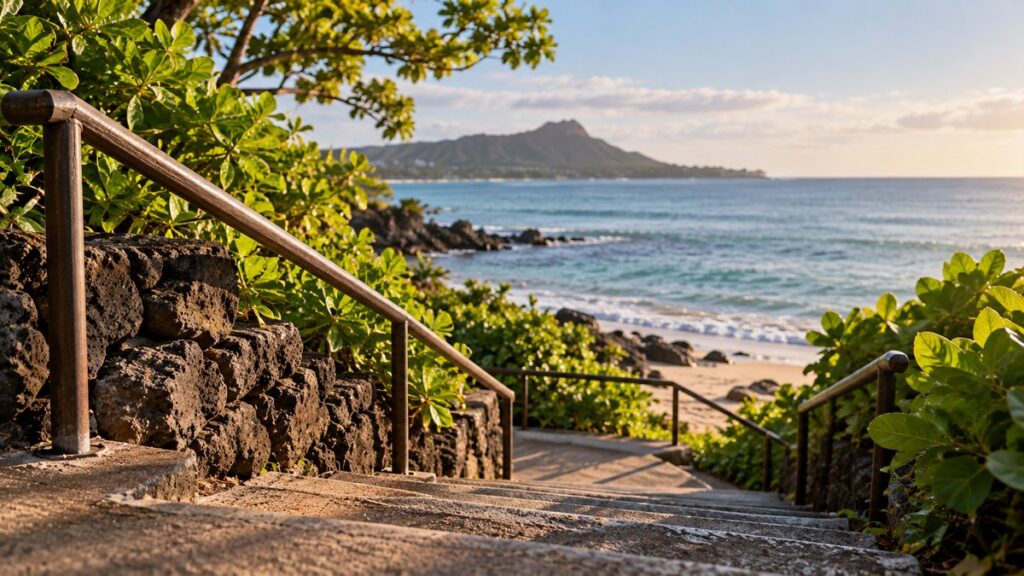
A trip to the beach should not end with an emergency room visit. Yet a deteriorating stairway, loose handrail, uneven walkway, or poorly maintained access path can cause a serious fall before someone even reaches the shoreline.
When an injury happens on a Hawaii beach access route, determining who may be responsible is not always straightforward. The path might be publicly owned, cross private land, or connect to a resort. The person or organization responsible for maintaining it may be different from the property owner.
That distinction matters when evaluating a potential injury claim.
At Rosenberg Hoffman, we help injured people understand their options under Hawaii law. Through our personal injury practice, we evaluate accidents involving potentially unsafe property conditions and questions about legal responsibility.
Understanding how beach access routes are owned, used, and maintained can help you identify the evidence needed to evaluate a claim.
Beach Access Injuries Differ From Falls on Natural Shorelines
Hawaii’s beaches include natural conditions that can make walking difficult. Wet rocks, shifting sand, uneven ground, and changing tides are common features of the shoreline.
An injury involving these conditions does not automatically mean someone was negligent.
A fall on a constructed access feature may present a different situation. Stairs, ramps, railings, paved walkways, and boardwalks are built structures that may require inspection, repair, or maintenance.
Consider two accidents.
In the first, someone loses their footing on naturally slippery rocks near the water. In the second, someone falls when a deteriorated step breaks on a designated beach access stairway.
Both people may suffer similar injuries, but the legal questions differ. The second incident raises potential questions about the stairway’s condition, maintenance history, and the responsibilities of whoever controlled it.
The distinction is not always clear-cut. Some access routes combine natural terrain with constructed features, and statutory protections may apply to certain recreational properties.
The relevant question is whether the circumstances support a legal claim against an identifiable responsible party, not simply whether the accident happened near a beach.
Ownership, Access Rights, and Maintenance Duties Determine Potential Liability
One of the most important steps in investigating a beach access injury is identifying the exact location of the fall.
A route may pass through multiple areas with different ownership or maintenance arrangements. For example, a path could begin near a public road, cross private property through an access easement, and connect to a beach.
An access easement generally allows certain use of land owned by someone else. However, permission for public access does not automatically establish who is responsible for maintaining every feature along the route.
Several parties may need to be considered:
- State or county agencies: Some public access routes and facilities are managed by government entities.
- Private property owners: An access path may cross privately owned land.
- Hotels and resorts: A beachfront property may maintain certain walkways, stairs, or facilities.
- Maintenance contractors: A separate company may perform inspections, landscaping, or repairs under an agreement.
Responsibility depends on the specific facts, applicable law, and relevant agreements.
A sign identifying a public beach access point does not necessarily establish that the government maintains the entire route. Similarly, a path beside a hotel is not automatically the hotel’s responsibility.
Property records, access documents, maintenance agreements, and incident reports may help clarify these questions.
This is why accurately identifying the particular stairway, landing, or walkway where the accident occurred can be more useful than simply recording the beach’s name.
Unsafe Stairs, Walkways, and Access Paths Create Different Safety Concerns
Not every hazardous condition suggests the same maintenance failure.
A damaged handrail raises questions about structural condition and repairs. Standing water may require examining drainage, weather, and whether the accumulation was reasonably foreseeable.
The table below identifies examples of potentially relevant hazards and evidence.
| Beach access hazard | Potential safety concern | Evidence that may help |
|---|---|---|
| Broken or deteriorated steps | Whether the stairway needed inspection or repair | Photographs, repair history, prior complaints |
| Loose or missing handrail | Whether the railing was adequately maintained | Images of attachments, damage, and surrounding stairs |
| Uneven constructed walkway | Whether deterioration created an unreasonable tripping risk | Photos showing the defect’s location and dimensions |
| Water accumulating on a path | Whether drainage or maintenance contributed to the condition | Weather information, drainage features, photographs |
| Vegetation covering a walkway | Whether growth obstructed visibility or safe passage | Wide-angle photos, maintenance records |
| Inadequate lighting | Whether poor visibility contributed to the accident | Lighting locations, time of incident, witness observations |
These conditions do not automatically establish negligence.
A claim generally requires evidence of an applicable legal duty, a breach of that duty, a causal connection to the injury, and legally recognized damages.
Whether the responsible party knew or reasonably should have known about the condition may also be important.
For example, records showing repeated complaints about a loose railing could be relevant. But the absence of prior complaints does not necessarily settle the issue, particularly when the hazard involves construction, inspection, or maintenance practices.
The surrounding circumstances determine what evidence matters most.
Evidence That Can Establish Responsibility for a Beach Access Injury
Evidence can help establish what caused an injury, who was responsible for maintaining the beach access route, and whether a dangerous condition should have been addressed. If you are injured on a beach access path, consider preserving the following information:
- Photographs of the hazardous condition. Take clear pictures of broken steps, loose handrails, uneven pavement, standing water, or other conditions that may have contributed to your fall. Include close-up and wider views to show the surrounding area.
- The exact accident location. Record the beach access point, nearby landmarks, signs, and the location of the hazard. A map pin can help distinguish a public walkway from a privately maintained path or resort entrance.
- Witness statements and contact information. If anyone saw the accident or noticed the condition beforehand, ask for their contact details. Their observations may help clarify what happened.
- Incident reports and official records. Report the accident to the appropriate property manager, resort representative, or public agency when possible. Request a copy of the report and keep a record of whom you contacted.
- Maintenance and inspection records. Records of prior complaints, inspections, repairs, or maintenance responsibilities may help establish who controlled the area and whether the hazard was known or should reasonably have been discovered.
- Medical records and treatment documentation. Seek appropriate medical attention and retain records of your injuries, diagnoses, treatment, and related expenses. These documents can help connect the accident to the harm you experienced.
- Changes to the accident scene. Beach access conditions can change because of weather, tides, vegetation, or repairs. Document relevant conditions as soon as safely possible, particularly if the hazard may later be altered or removed.
Not every piece of evidence will be available immediately. The goal is to preserve accurate information without speculating about who was at fault. An attorney can help determine which additional records may be needed to investigate responsibility for the access route.
Public Access and Recreational Use Laws Can Limit Liability
Public access does not automatically mean a government agency is liable for an injury.
Likewise, the fact that an access route crosses private property does not necessarily mean the landowner is responsible.
Hawaii has laws that may limit liability in certain recreational settings.
Under Hawaii Revised Statutes Chapter 520, qualifying landowners who permit recreational use of their property without charge may receive statutory protections, subject to the law’s requirements and exceptions.
These protections can be relevant when evaluating injuries on land used for recreational access.
Their application depends on factors such as the property’s use, the circumstances of access, the alleged conduct, and the specific statutory provisions involved.
Government property may also involve additional legal defenses or limitations.
A maintained walkway does not automatically fall outside recreational use protections, just as a public access sign does not establish that those protections apply.
The facts must be examined carefully.
For someone injured on a beach access stairway, this means the investigation should address not only whether a hazard existed, but also the property’s legal status and any laws affecting the potential defendant’s liability.
Comparative Negligence Can Affect Compensation
Even when a dangerous condition contributed to a fall, an insurer may argue that the injured person also failed to exercise reasonable care.
Examples might include entering a clearly closed area, disregarding a visible warning, or continuing along a route despite an obvious danger.
Under HRS §663-31, Hawaii follows a modified comparative negligence rule.
An injured person’s recoverable damages may be reduced according to their percentage of fault. Recovery is generally barred when their negligence exceeds the combined negligence of the defendants against whom recovery is sought.
However, wearing sandals, encountering wet conditions, or seeing a warning sign does not automatically establish fault.
The location, available alternatives, visibility, warnings, and circumstances of the accident all matter.
Photographs taken soon after the fall may help clarify these details.
Government and Private Property Claims Have Different Filing Requirements
Determining the responsible party also matters because different legal procedures may apply.
For many personal injury lawsuits, HRS §657-7 establishes a general two-year limitations period, subject to applicable exceptions.
Claims against government entities may involve additional statutory requirements.
For certain county injury claims, HRS §46-72 requires written notice within two years after the injuries accrue. The statute specifies information that the notice must contain.
Claims against the State may be governed by the State Tort Liability Act, including HRS §662-4, which generally establishes a two-year period for covered tort claims, subject to applicable exceptions.
These laws should not be treated as interchangeable.
The appropriate deadline, notice procedure, and potential defenses depend on the entity involved and the circumstances of the injury.
Importantly, submitting an ordinary incident report does not necessarily satisfy a statutory claim-notice requirement.
Waiting can also make it harder to locate witnesses, obtain records, or document conditions before repairs occur.
If you are uncertain whether a beach access route is publicly or privately maintained, obtaining legal advice early may help prevent that uncertainty from affecting your ability to pursue a claim.
Discussing a Beach Access Injury With Rosenberg Hoffman
A beach access injury may involve more than a damaged step or slippery walkway. Establishing a potential claim can require identifying who controlled the location, determining maintenance responsibilities, reviewing available evidence, and considering statutory defenses.
Those questions are difficult to resolve from photographs or public access signs alone.
At Rosenberg Hoffman, our personal injury attorneys help injured people evaluate their circumstances and understand possible next steps under Hawaii law.
A consultation can address where the fall occurred, what condition contributed to it, the injuries involved, and the evidence available.
We offer free consultations, with offices in Honolulu and Waipahu. Phone and video consultations are also available.
If you were injured on a Hawaii beach access stairway, walkway, or maintained path, contact Rosenberg Hoffman or call 808-470-4819 to discuss your situation.
This article provides general information and is not legal or medical advice. Liability, filing requirements, and potential compensation depend on individual circumstances and applicable law. Reading this article or contacting the firm does not, by itself, establish an attorney-client relationship. Please review our Legal Disclaimer.
