

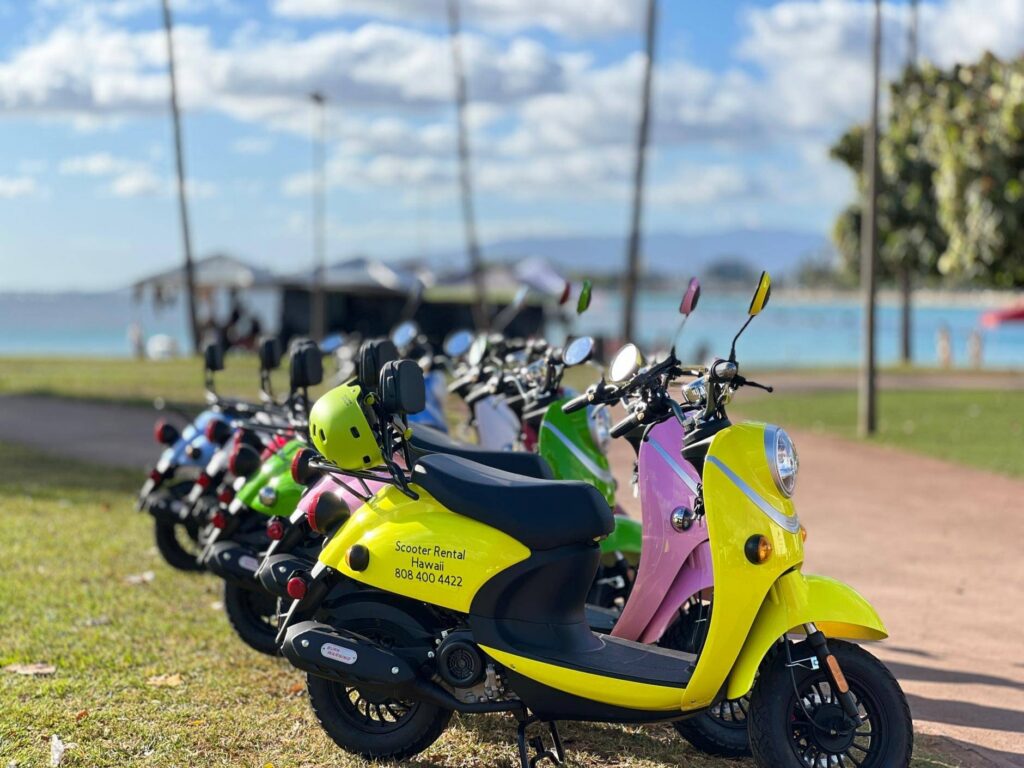
Cruising down Kalakaua Avenue in Waikiki or riding along the scenic paths of Diamond Head on a rented moped or electric scooter feels like the ultimate way to experience Honolulu. It’s affordable, convenient, and lets you skip the nightmare of tourist parking on Oahu.
Because of this popularity, rental kiosks are on almost every corner in high-traffic tourist areas. However, what most visitors—and even many local residents—do not realize is that Hawaii’s insurance laws treat mopeds and e-scooters completely differently than standard rental cars.
If you are struck by a vehicle while riding a moped or shared e-scooter, you can easily find yourself caught in a devastating legal loophole, facing tens of thousands of dollars in personal medical debt. Before you sign a rental waiver and slide on a helmet, here are 5 crucial Hawaii insurance rules you absolutely need to know.
1. The Motorcycle/Moped PIP Loophole: You are Stripped of “No-Fault” Medical Benefits
Hawaii is strictly a no-fault auto insurance state. This means if you are inside a standard passenger car during a crash, your own auto policy’s Personal Injury Protection (PIP) automatically steps in to pay your first $10,000 of emergency room and doctor bills, regardless of who caused the wreck.
However, under Haw. Rev. Stat. § 431:10C-103, mopeds and motorcycles are explicitly excluded from mandatory PIP medical benefits.
What this means for you: If you rent a moped and get struck by an inattentive driver on the Ala Wai Boulevard, there is no automatic “no-fault” insurance pool to pay your immediate hospital bills. The primary insurance attached to the moped will not cover your medical stabilization, leaving a massive financial gap from moment one.
2. Your At-Home Auto Insurance Policy Likely Excludes Two-Wheeled Rentals
When you rent a standard sedan or SUV at Daniel K. Inouye International Airport, your personal car insurance policy from back home (or the credit card you used to book the vehicle) frequently extends collision and liability coverage to your rental.
This protection completely vanishes the moment you switch to two wheels. The vast majority of standard mainland and local auto insurance policies explicitly exclude any vehicles with fewer than four wheels from their rental car ridership extensions. Unless you carry a highly specific motorcycle or power-sports endorsement that covers temporary rentals, your personal auto insurer will likely deny any claims resulting from a moped or scooter crash.
3. Credit Card Rental Protections Do Not Cover Mopeds or Shared E-Scooters
It is a common travel hack to rely on premium credit cards (like Chase Sapphire or American Express) for secondary or primary rental vehicle protection. While these programs are excellent for standard cars, their fine print contains ironclad exclusions for:
- Mopeds, motorized bicycles, and vespas.
- Two-wheeled and three-wheeled vehicles.
- Open-chassis electric rides or dockless app-based scooters (like Lime or Bird).
If you crash a rented moped into a stationary object or cause damage to someone else’s property, you cannot fall back on your credit card company to cover the property damage or liability bills.
4. Rental Company Liability Insurance Only Protects Them, Not Your Health
When you rent a moped in Honolulu, the business is legally required to carry basic property damage and bodily injury liability limits. However, many tourists misunderstand what this baseline policy covers.
A rental kiosk’s standard liability insurance is designed to protect the rental business from third-party lawsuits and provide minimal coverage to other people if you cause an accident. It does not function as health insurance for you. If a hit-and-run driver knocks you off your moped, or if you lose traction on wet roads and fracture a collarbone, the rental company’s policy will pay $0 toward your ambulance ride or surgeries.
5. Your Out-of-State Private Health Insurance May Treat Excursions Differently
If you are a tourist visiting Oahu from the mainland, your primary defense after a moped crash is your private health insurance policy (such as Blue Cross, Aetna, or Kaiser). Your health provider will handle your emergency room treatments at local trauma hubs like The Queen’s Medical Center, but you face two distinct hurdles:
- Out-of-Network Penalties: If your health plan lacks emergency reciprocity agreements on Oahu, you could face massive out-of-network deductibles and co-pays.
- Subrogation Clauses: If your health insurance company pays $50,000 for your accident care, their internal “subrogation” department will aggressively demand reimbursement out of any eventual personal injury settlement you win from the at-fault driver.
Quick Comparison: Car Rental vs. Moped Rental Insurance
| Insurance Feature | Standard Hawaii Car Rental | Honolulu Moped/Scooter Rental |
|---|---|---|
| No-Fault Medical (PIP) | Yes (Minimum $10,000) Automatically covers initial ER and doctor bills. | No (Explicitly Excluded) No automatic medical coverage pool exists. |
| At-Home Auto Extension | Common Mainland auto policies routinely cover rental cars. | Extremely Rare Standard policies strictly exclude fewer than 4 wheels. |
| Credit Card Protection | Standard Covers collision damage and theft. | None Credit cards explicitly exclude mopeds and e-scooters. |
| Primary Claim Path | Covered via PIP first, then third-party bodily injury claim. | Must bypass no-fault rules and pursue direct third-party liability instantly. |
What Should You Do If You Are Injured in a Honolulu Moped or Scooter Accident?
Because you lack automatic PIP medical coverage, navigating the legal aftermath of a moped or scooter crash requires moving aggressively from day one. If you are struck by a negligent motorist, take these immediate steps to preserve your rights:
- Call 808-529-3111 to Alert HPD: Ensure the Honolulu Police Department responds to the scene to create an official motor vehicle accident report. This report is vital to proving liability later.
- Document Everything: Photograph the positioning of the moped, the damage to the striking vehicle, skid marks, road conditions, and the rental waiver documentation.
- Identify Eyewitnesses: Collect names and phone numbers of bystanders who saw the crash before they walk away into crowded resort areas like Waikiki.
- Seek Medical Treatment Immediately: Go directly to an urgent care or emergency room. Documenting your physical injuries within hours of the crash prevents insurance adjusters from claiming your trauma happened later.
- Do Not Give a Recorded Statement to the Rental Kiosk: The rental company’s internal insurance investigators are trained to limit corporate liability. Speak with a local trial attorney before signing anything or giving a recorded account of the crash.
Real Trust: What Our Clients Say About Our Representation
When navigating complex liability rules and stubborn insurance loops, experience matters. Here is how we have helped injury victims and families navigate challenging claims across Hawaii:
Read Mark C.‘s review of Rosenberg McKay Hoffman on Yelp Read Gayle N.‘s review of Rosenberg McKay Hoffman on Yelp Read Diana C.‘s review of Rosenberg McKay Hoffman on YelpSpeak with a Local Honolulu Personal Injury Attorney For Free
If you or a loved one has been seriously injured while riding a rented moped or e-scooter on Oahu, do not let corporate insurance adjusters or confusing no-fault exemptions derail your recovery.
At Rosenberg Hoffman, we understand how to navigate Hawaii’s complex rental loopholes to hunt down alternative insurance coverage pools—including underinsured motorist (UIM) paths or corporate fleet liability. Our downtown Honolulu team has fought for the rights of accident victims and out-of-state tourists since 1995.
We handle all personal injury claims on a strict contingency-fee basis, meaning you pay absolutely nothing out of pocket, and we collect zero legal fees unless we successfully win financial compensation for you.Let Us Help
