


If you’ve been injured in a car accident on Oahu, one of the first pieces of legal advice you’ll likely hear is that Hawaii is a no-fault insurance state.
Unfortunately, this term causes a massive amount of confusion for accident survivors. Many people mistakenly believe that “no-fault” means no one is held responsible for causing a collision, or that they are completely blocked from filing a lawsuit against a reckless driver.
Neither of those assumptions is true.
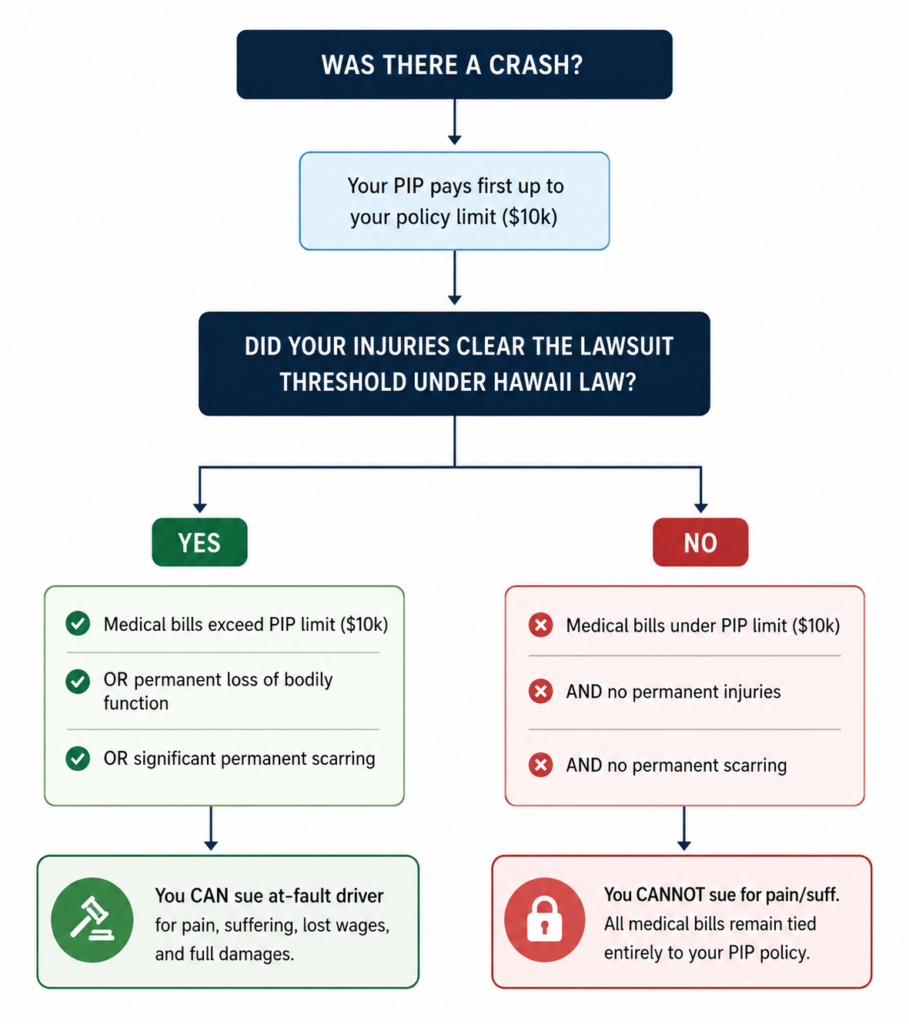
In Hawaii, the no-fault system strictly dictates who pays for your initial medical treatment. However, when injuries are severe, the law provides a clear pathway to step outside the no-fault system and sue the negligent motorist for your full damages. To do that, your case must clear Hawaii’s legal lawsuit threshold.
Here is a plain-English breakdown of exactly how the no-fault medical threshold works and when you have the right to file a personal injury lawsuit.
The Starting Point: Personal Injury Protection (PIP)
Under Hawaii law, every driver is required to carry a minimum of $10,000 in Personal Injury Protection (PIP) coverage.
When a crash occurs, your own PIP insurance pays for your medical treatments, surgeries, and rehabilitation costs up to your policy’s limit—regardless of who caused the accident. Because your own insurer pays first, you don’t have to wait for a lengthly legal battle to finish just to get your emergency room bills covered.
The catch? Your PIP policy only covers medical expenses. It does not pay for your physical pain and suffering, emotional distress, or the full scope of your long-term lost wages. To recover those quality-of-life damages, you must file a third-party personal injury claim against the at-fault driver’s insurance.
The Lawsuit Threshold: When Can You Step Outside the System?
To protect the courts from being flooded with minor claims, Hawaii statute (Haw. Rev. Stat. § 431:10C-306) states that you cannot sue the at-fault driver unless your injuries meet specific criteria.
You can break past the no-fault restrictions and file a lawsuit if your case meets at least one of the following thresholds:
1. The Financial/Medical Threshold
You have exhausted your PIP medical benefits. If you carry the standard mandatory minimum policy, this means your accident-related medical bills must exceed $10,000. Given the astronomical cost of modern emergency medical care, a single ambulance ride, a couple of X-rays, and a night at a Honolulu trauma center will routinely push you past this threshold instantly.
2. The Significant Injury Threshold
If your medical bills haven’t quite cleared the financial limit yet, you can still file a lawsuit if the crash directly caused:
- Significant permanent scarring.
- Serious and permanent disfigurement.
- The permanent loss of an important bodily function.
3. Wrongful Death
If a loved one tragically lost their life in a fatal collision, the no-fault restrictions do not apply. The surviving family members or the estate representative have the immediate right to file a wrongful death claim against the negligent party.
Quick Summary: Can I File a Lawsuit?
Beware of the “Shared Blame” Rule: Comparative Negligence
Once you clear the medical threshold and file a lawsuit, you must also navigate Hawaii’s 51% modified comparative negligence rule (Haw. Rev. Stat. § 663-31).
The at-fault driver’s insurance company will routinely try to twist the facts to claim that you were partially to blame for the accident in order to lower their payout. Under Hawaii law, you can still recover financial compensation as long as your share of the blame is 50% or less. However, your total compensation check will be reduced by your exact percentage of fault.
Example: If a jury determines your total damages are worth $100,000, but finds you were 20% at fault for speeding through the intersection when an inattentive driver turned left in front of you, your final recovery payout will be reduced to $80,000. If you are found 51% or more at fault, you are legally barred from recovering any damages at all.
Real Trust: What Our Clients Say About Our Representation
When fighting aggressive insurance adjusters who are trying to minimize your injuries or shift the blame to you, having an experienced local advocate in your corner makes all the difference. Here is how we have helped injury survivors across Oahu find closure and results:
Read Diana C.‘s review of Rosenberg McKay Hoffman on Yelp Read Christianna S.‘s review of Rosenberg McKay Hoffman on YelpProtect Your Rights: Speak with a Honolulu Car Accident Attorney
Navigating the intersection of PIP policies, medical thresholds, and comparative fault rules while trying to physically heal from a major wreck is incredibly difficult. Insurance providers are for-profit corporations that want to keep your claim under the threshold or convince you to accept a small, fast settlement check before you know the true cost of your future medical needs.
At Rosenberg Hoffman, we understand Hawaii auto insurance laws inside and out. Since 1995, our legal team has been helping car accident victims across Oahu protect their families and secure maximum compensation. When you call our firm, you will always speak directly with your attorney, never a paralegal.
We protect injury survivors from our offices in downtown Honolulu and Waipahu. We work on a strict contingency-fee basis, which means there are absolutely no upfront costs, and we collect zero legal fees unless we successfully win your case.
