


For many survivors of childhood sexual abuse, the psychological and emotional trauma can take decades to fully process. The human brain often buries horrific memories as a defense mechanism, a phenomenon known as traumatic amnesia. In other instances, survivors carry the weight of the abuse in silence for a lifetime due to the intense shame, fear, and institutional pressure forced upon them by the organizations that failed to protect them.
When a survivor finally reaches a place of strength where they are ready to seek legal accountability, they are often met with a terrifying legal question: Has too much time passed to file a lawsuit?
Historically, old laws favored powerful institutions by locking survivors out of the courtroom using short, restrictive time limits known as statutes of limitations. However, in recent years, the State of Hawaii has completely overhauled its civil justice system. Recognizing that trauma does not operate on a standard clock, local lawmakers have opened powerful legal windows to ensure that survivors of historical civil sexual abuse can seek justice—even if the abuse occurred decades ago.
What is a Statute of Limitations, and How Did It Used to Work?
A statute of limitations is a strict statutory deadline dictating how long an individual has to file a civil personal injury lawsuit after an injury occurs. In a standard Hawaii personal injury case (such as a car accident or slip-and-fall), the baseline statute of limitations is strictly two years from the date of the incident.
For childhood sexual abuse claims, the old legal framework was devastatingly restrictive. The legal clock would typically begin running on the survivor’s 18th birthday (when they reached the legal age of majority) and expire just a few years later. For decades, this framework protected negligent school districts, private academies, and religious organizations, allowing them to escape financial and legal liability simply by keeping a survivor silent until their early twenties.
Hawaii’s Legal Overhaul: Erasing the Clock for Childhood Abuse Survivors
Recognizing the deep injustice of the old deadlines, the Hawaii State Legislature took aggressive action to tear down these protective walls for institutional predators. Through a series of crucial legal reforms, Hawaii has significantly extended and, in many contexts, completely eliminated the statute of limitations for civil claims brought by survivors of childhood sexual abuse.
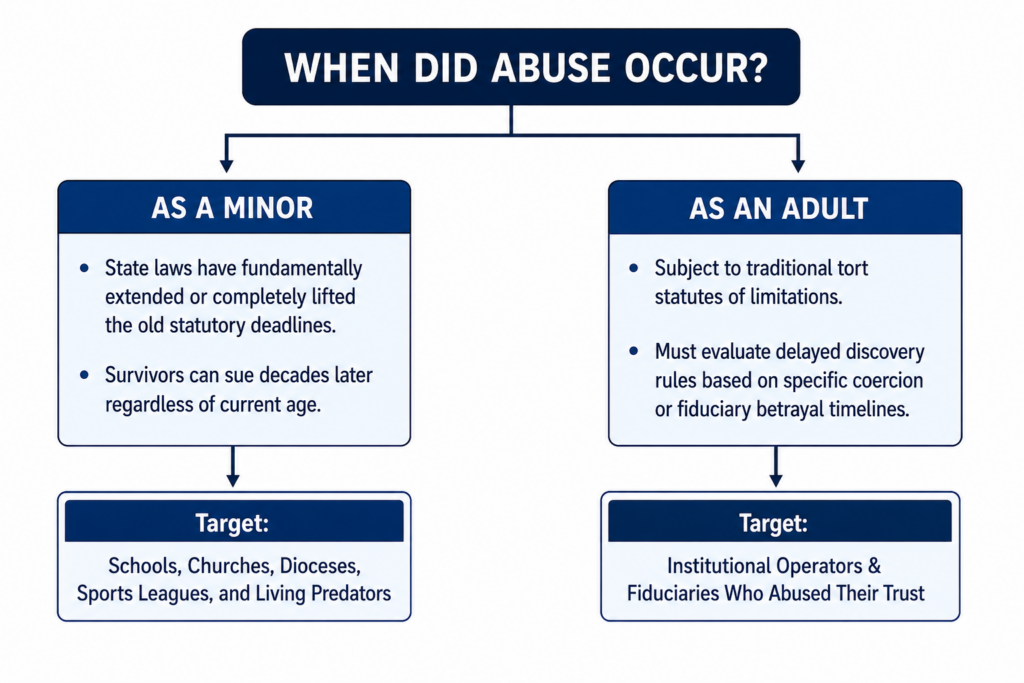
Because of these progressive legislative rollbacks, your current age is no longer an automatic barrier to filing a civil claim. Whether you are in your 30s, 50s, or 70s, if you were victimized as a minor inside a Hawaii school, church, youth camp, or sports league, the law provides a clear path to hold both the living predator and the underlying organization civilly liable for their systemic failures.
Tracking the Look-Back Windows and Institutional Liability
When building a historical abuse claim, your legal team evaluates the specific timelines and boundaries of Hawaii’s look-back windows to determine the strongest path forward. These laws allow survivors to target powerful organizations for their historical negligence, including:
1. Direct Civil Actions Against Living Perpetrators
The law ensures that individual predators cannot escape civil justice by hiding behind the passage of time. Adult survivors can initiate lawsuits directly against their abusers to hold them financially responsible for the lifelong physical, emotional, and economic trauma they inflicted.
2. Targeting Systemic Institutional Cover-Ups
Most historical claims are filed against the institutions—such as public school boards, private parochial academies, or church dioceses—that enabled the predator. We construct powerful cases by proving the organization committed independent negligence, such as:
- Negligent Supervision: Allowing a known predatory staff member unrestricted, unmonitored access to children.
- Systemic Cover-Ups: Quieting victim complaints, threatening families, or secretly transferring an abuser to a different facility or parish rather than alerting law enforcement.
- Negligent Retention: Keeping an individual on the payroll despite repeated warning signs or parallel allegations from parents.
Quick Reference: Hawaii Civil Deadlines for Institutional Abuse
| Type of Claim | Historical Statutory Rule | Historical Statutory Rule |
|---|---|---|
| Childhood Sexual Abuse | Expired a few years after turning 18. | Lifted / Extended Survivors can file claims decades later regardless of current age. |
| Adult Institutional Abuse | Strictly limited to a 2-year window. | Evaluated on Discovery Clock may be paused if there was severe coercion or fraud. |
| Deceased Perpetrator Claims | The individual claim dies with the predator. | Institutional Action Remains You can still aggressively sue the surviving entity/school. |
| Public Entity/State Claims | Restrictive administrative notice rules. | Look-Back Windows Apply Special statutes allow claims against public school districts. |
Real Trust: What Our Clients Say About Our Dedicated Representation
Navigating historical institutional trauma requires an experienced, tenacious legal team that treats your story with absolute dignity and privacy. Here is how we have stood by survivors and families across Hawaii:
Read Mark C.‘s review of Rosenberg McKay Hoffman on Yelp Read Gayle N.‘s review of Rosenberg McKay Hoffman on YelpSpeak with a Compassionate Honolulu Abuse Attorney Completely Confidentially
If you are an institutional survivor considering exploring your legal options, please know that you do not have to carry this burden alone, and your voice deserves to be heard. Do not assume that because your abuse occurred years or decades ago that you are automatically locked out of the civil justice system.
At Rosenberg Hoffman, we understand the complex legal nuances of Hawaii’s look-back laws and statute of limitations extensions. Since 1995, our Honolulu trial lawyers have stood firmly beside survivors of childhood and adult institutional abuse, helping them bring hidden truths to light.
When you contact our firm, your consultation will be conducted in a completely safe, private, and 100% confidential environment directly with an experienced attorney. We move entirely at your pace, and we handle all litigation on a strict contingency-fee basis—you pay absolutely nothing upfront, and we collect zero legal fees unless we successfully win your civil case.
