

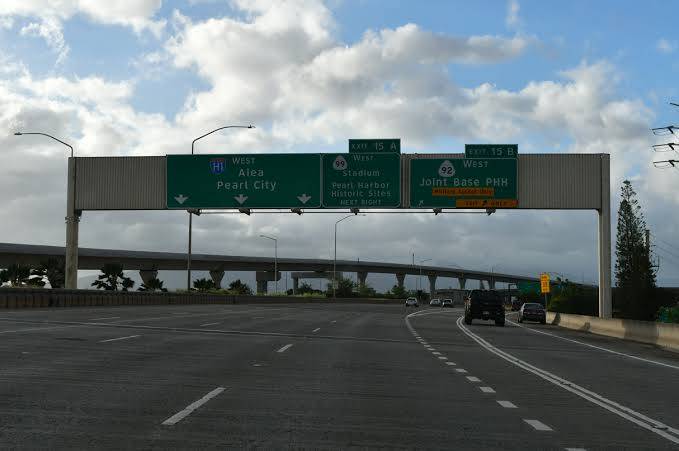
Interstate H-1 West highway approaching the Joint Base Pearl Harbor-Hickam exit. Source: AARoads
Serving as an active-duty service member stationed on Oahu—whether you are attached to Joint Base Pearl Harbor-Hickam, Marine Corps Base Hawaii (MCBH) in Kaneohe, the Coast Guard at Sand Island, or Schofield Barracks—presents unique lifestyle and transit realities. Commuting along the crowded corridors of the H-1 Freeway, Nimitz Highway, or Kamehameha Highway means navigating the exact same daily traffic risks as local civilians.
Tragically, severe motor vehicle collisions are an all-too-regular occurrence for local military personnel and their dependents on our island roads.
If you are a service member currently recovering from a severe crash on Oahu, you face a distinct set of federal and state legal rules that do not apply to civilian commuters. A common piece of misinformation floating around local bases is that military members cannot file personal injury lawsuits due to federal restrictions.
This misunderstanding stems from a misapplication of a federal rule known as the Feres Doctrine. If you are injured in an off-base collision caused by a negligent civilian driver, the Feres Doctrine does not block your civil action. However, securing a fair personal injury settlement requires understanding how military status, Tricare medical liens, and Hawaii insurance rules interface.
Dismantling the Base Myth: The Parameters of the Feres Doctrine
The Feres Doctrine is a powerful legal rule established by the U.S. Supreme Court in 1950. It bars active-duty service members from suing the federal government for injuries that occur “incident to military service.” For example, if you suffer medical malpractice at Tripler Army Medical Center or are injured during a training exercise on base, you are legally restricted from filing a standard civil tort lawsuit against the government.
Crucially, the Feres Doctrine has absolutely no application to off-base car accidents caused by negligent civilian motorists or private entities.
- Off-Base Civilian Wrecks: If you are off-duty, driving your personal vehicle outside base gates, and a distracted civilian driver runs a red light and broadsides you, you retain the exact same civil rights as any civilian. You have the full legal right to file a third-party personal injury lawsuit against the at-fault motorist to recover financial damages.
- On-Base Civilian Wrecks: Even if a crash occurs on federal property, if the at-fault driver is a private civilian contractor or a non-military visitor, a civil tort action can routinely be pursued outside the federal framework.
Navigating the Tricare Lien and the Auto PIP Hierarchy
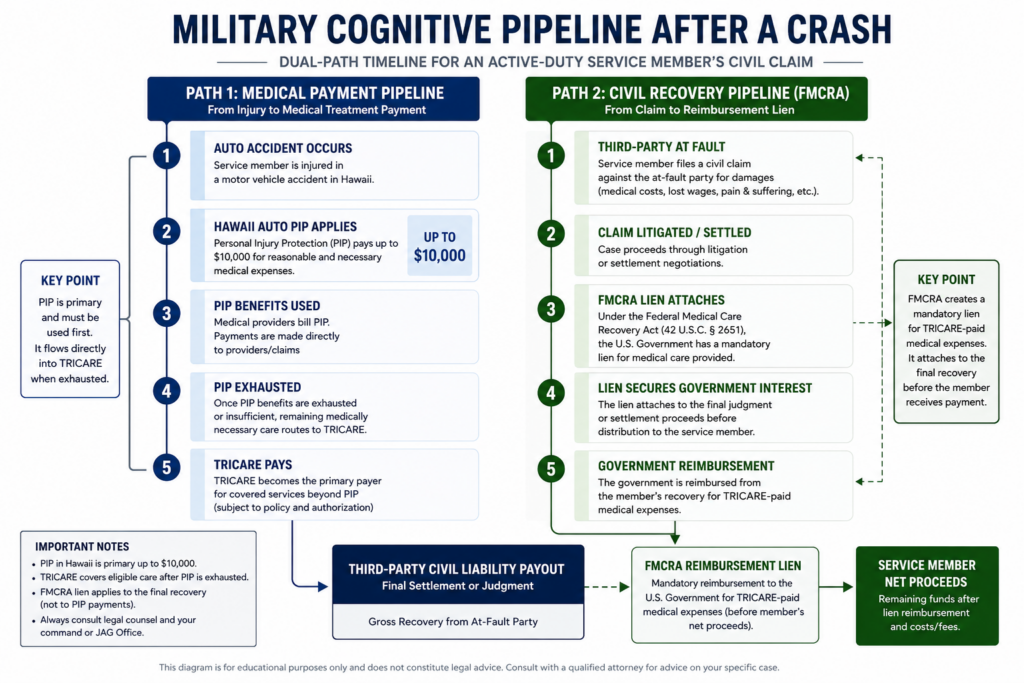
Because Hawaii is strictly a no-fault insurance state, your immediate path to managing emergency medical bills follows a very specific structural sequence. Under state auto regulations, the vehicle you were inside during the impact provides the first line of medical payment through mandatory Personal Injury Protection (PIP) benefits, up to a statutory baseline of $10,000. You can review this primary framework on our What You Should Know About Hawaii’s No-Fault Insurance Law page.
Once the initial $10,000 auto PIP layer is exhausted, your military health benefits via Tricare step into the secondary payment position to cover your ongoing surgeries, specialized imaging, and rehabilitation.
The Federal Medical Care Recovery Act (FMCRA)
While Tricare handles your medical treatments, the federal government does not absorb those costs permanently. Under the Federal Medical Care Recovery Act, the standard military Judge Advocate General (JAG) Corps or Treasury Department is legally mandated to assert a Federal Medical Lien against your personal injury claim.
When your personal injury lawyer successfully recovers a financial settlement check from the at-fault civilian’s insurance provider, the government will demand to be reimbursed dollar-for-dollar out of that recovery for the cost of your Tricare-funded treatments. Successfully resolving a military injury claim requires a legal team that knows how to aggressively negotiate with federal recovery adjusters to reduce these liens, keeping the maximum amount of settlement money in your pocket.
Breaking Past the Local Lawsuit Threshold to Secure Full Compensation
To file a direct lawsuit against the negligent civilian driver for non-economic damages like pain and suffering, your physical trauma must break past Hawaii’s no-fault legal threshold barriers. Because high-speed freeway or highway impacts routinely result in significant injuries, military claims regularly clear these markers by proving:
- Your comprehensive accident-related medical treatments exceed the initial $10,000 PIP allocation.
- The physical trauma results in a permanent injury, severe permanent scarring, or the chronic loss of an important bodily function.
Once your claim breaks through the no-fault threshold, you can pursue the civilian’s insurance network for full quality-of-life damages, future out-of-pocket medical costs, and lost specialized military career allowances. To see how local courts calculate these figures, review our comprehensive resource on What Compensation Can You Recover for a Hawaii Personal Injury Case?.
Quick Reference: Military Car Crash Legal Variables
- Legal Constraint: The Feres Doctrine Impact on Active-Duty Claims: Does Not Apply to off-base collisions caused by negligent private citizens or commercial fleets.
- Immediate Medical Cover: Hawaii Auto PIP Impact on Active-Duty Claims: Primary payer position. Covers the first $10,000 of emergency billing regardless of fault status.
- Secondary Medical Cover: Tricare Health Benefits Impact on Active-Duty Claims: Secondary payer position. Covers costs exceeding $10,000, subject to federal statutory reimbursement liens.
- Final Recovery Target: Civilian Bodily Injury Policy Impact on Active-Duty Claims: Pays for pain and suffering, out-of-pocket losses, and satisfies the outstanding federal subrogation lien.
Real Trust: Professional Representation Combined with Aloha
Untangling federal statutory medical liens, confronting aggressive civilian insurance networks, and defending the rights of our service members requires a highly professional local trial team. You can view our long history of managing complex motor vehicle actions on our Case Results page. Here is how our firm stands firmly beside families throughout Oahu:
“Randall and James are very very professional with a bucket full of Aloha! Great lawyers!” — Susan J., Verified Google Review via Attorney at Law
Protect Your Military Injury Claim: Contact Rosenberg Hoffman
If you are an active-duty service member, a veteran, or a military dependent recovering from a severe motor vehicle crash on Oahu, do not allow an insurance adjuster to confuse you regarding your civil rights. Corporate insurance adjusters will use your military status to make misleading claims, attempting to resolve your file with a quick, insufficient settlement before the true scope of your future medical rehabilitation is fully understood.
At Rosenberg Hoffman, our Honolulu personal injury lawyers have been fighting for the rights of local commuters, downed riders, and service members since 1995. We take over all direct communication with civilian insurance adjusters, manage the complex interaction between state auto policies and Tricare benefits, and coordinate directly with federal agencies to handle your medical liens cleanly.
We protect injury survivors across a comprehensive suite of local traffic practice categories. Whether your case involves standard Car Accidents, severe highway collisions caused by heavy commercial vehicles under Truck Accidents, or catastrophic crashes caused by reckless Drunk Drivers, our trial lawyers have the experience needed to win.
We excel at protecting vulnerable commuters in Motorcycle Accidents and Moped, Bicycle, and Pedestrian Accidents. We specialize in managing the unique jurisdictional overlaps tied directly to Tourist and Military Injuries. If your injury occurred due to poorly maintained premises adjacent to an off-base commercial property, we manage Slip/Trip-and-Fall Injuries and animal attacks under Dog Bites and Attacks. In the most heartbreaking instances, we provide steady, compassionate representation for families seeking stability through Wrongful Death actions.
When you choose our firm, you deal directly with your dedicated trial lawyer, never an assistant. We handle all personal injury litigation on a strict contingency-fee basis—you pay absolutely nothing upfront, and we collect zero legal fees unless we successfully win your financial settlement.
Call 808-470-4819 or visit https://rhlawhi.com/contact/ to schedule a free, 100% confidential case evaluation.
