

Sending your child to school on Oahu should mean placing them in a safe, nurturing environment where their well-being is aggressively protected. Tragically, childhood misconduct—ranging from severe, unaddressed bullying and physical assaults to predatory behavior by staff or fellow students—regularly upends the lives of local families.
When a school administration fails to supervise students, ignores clear warning signs, or actively conceals bad behavior, the physical and emotional trauma can alter a child’s entire developmental future.
If your child has suffered severe harm at school, taking legal action is vital to secure the financial resources needed for long-term medical care and specialized psychological counseling. However, the legal roadmap you must follow depends entirely on the type of school your child attends.
Pursuing a case against a state-run public school involves a completely different set of statutory deadlines and legal immunities than filing a personal injury claim against a privately operated institution. Failing to understand these hidden structural differences can result in your family’s case being thrown out of circuit court before it even begins.
The Core Difference: How School Type Controls Your Legal Strategy
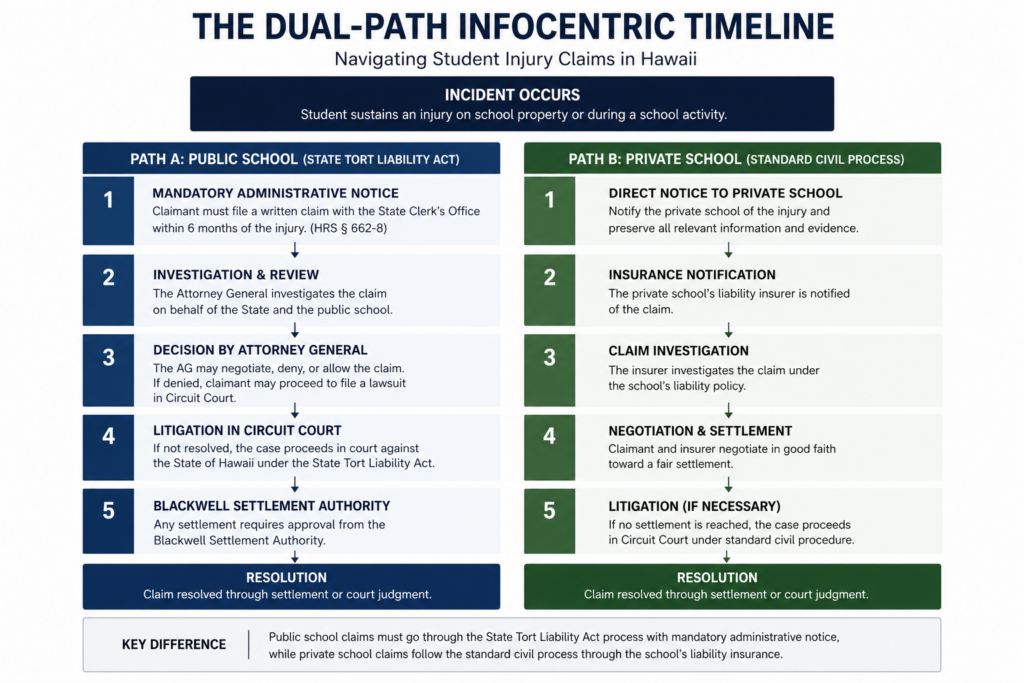
To help you visualize why the institutional category dictates your legal options, review this side-by-side comparison of procedural steps and financial limits:
| Legal Benchmark | Hawaii Public School Claim (DOE) | Hawaii Private School Claim |
|---|---|---|
| Primary Target Entity | The State of Hawaii Department of Education. | The private corporate board or religious parent group. |
| Governing Framework | Hawaii State Tort Liability Act (Haw. Rev. Stat. Chapter 662). | Standard Common Law Premises Liability and contract law. |
| Statutory Filing Trap | Strict administrative notice requirements apply before you can file a civil action. | Direct civil complaints are filed straight into the Hawaii Circuit Court. |
| Standard Legal Deadlines | Strict statutory clocks apply; missing initial administrative steps permanently bars your recovery. | Standard two-year personal injury windows apply, with tolling protections for minors. |
| Earning Capacity Claims | Focused strictly on absolute economic losses and actual past and future therapy expenses. | Can pursue broad corporate policy payouts, structural damage awards, and contract breaches. |
Suing Public Schools: Navigating the State Tort Liability Act
When a child is harmed inside a Hawaii Department of Education (DOE) public facility, you are not suing a private entity; you are attempting to sue a sovereign government. Under historical legal doctrines, the government is protected by sovereign immunity unless it explicitly grants permission to be sued.
The state grants this permission strictly through the Hawaii State Tort Liability Act under Haw. Rev. Stat. Chapter 662. To successfully hold a public school accountable for negligent supervision or failing to stop ongoing student misconduct, your legal team must follow highly specific, rigid guidelines:
The Public Institution Rules:
- Proving Negligent Supervision: You must demonstrate that the school staff had a specific duty to supervise the students at that exact time, that they failed in that duty, and that the lack of oversight directly allowed the foreseeable misconduct to happen.
- The Discretionary Function Trap: State defense attorneys will aggressively argue that high-level administrative decisions—such as how a school allocates its security budget or shapes its broad anti-bullying policies—are protected discretionary acts that cannot be questioned in court. Your lawyer must focus the case on the operational failures of individual teachers and principals on the ground.
To see how local circuit courts evaluate these types of economic and emotional damages for local students, read our dedicated overview on What Compensation Can You Recover for a Hawaii Personal Injury Case?.
Suing Private Schools: Utilizing Premises Liability and Contract Law
Filing a civil claim against an Oahu private academy, independent preschool, or religious school bypasses the restrictive State Tort Liability Act entirely. Instead, these facilities are treated as private commercial businesses under standard Hawaii premises liability laws.
Private schools owe their student body the highest duty of care as business invitees. When you pay tuition, an explicit contract is created. This contract obligates the school administration to maintain a safe, secure, and properly supervised educational environment.
Our personal injury lawyers build powerful third-party private school claims around these common institutional breakdowns:
- Breach of Internal Security Protocols: If a private academy fails to run mandatory background checks on personnel, permits unauthorized visitors to roam common areas, or leaves secluded classrooms unmonitored, they hold direct liability for the resulting harm.
- Failure to Enforce Student Handbooks: Private schools regularly market their campuses as highly secure, zero-tolerance environments. If an administrator fails to expel or discipline a student who has a known history of violent behavior or sexual misconduct, the school can be sued for breach of contract and operational negligence.
- Targeting Corporate and Umbrella Policies: Private schools carry substantial commercial general liability (CGL) policies and multi-million dollar corporate umbrella coverages. These assets are vital for securing the long-term funds required to cover comprehensive psychological care, trauma rehabilitation, and future educational transfers.
Overcoming the Comparative Fault Defense Against Minors
Whether your child’s case targets a public school district or a private school board, the defense team’s corporate risk adjusters will attempt to utilize Haw. Rev. Stat. § 663-31, Hawaii’s 51% Modified Comparative Negligence Rule. They will try to claim that your child initiated the conflict, failed to report the issues, or willingly participated in the misconduct. If they can successfully shift 51% or more of the legal blame onto the young victim, the insurance network does not have to pay a single cent for your family’s damages.
To defeat these victim-blaming defense tactics, our legal team moves quickly to build an unyielding wall of objective evidence. We subpoena internal school incident logs, secure neighborhood security camera footage surrounding the campus, take detailed statements from student witnesses before they can be coached, and review past disciplinary records to show a clear history of administrative neglect.
Unlike minor auto accident claims that are initially limited by no-fault thresholds, institutional premises liability and childhood injury actions allow you to pursue direct compensation for your total out-of-pocket costs and overall quality-of-life damages from day one.
Frequently Asked Questions About Hawaii School Misconduct Claims
How long do I have to file a lawsuit against a school in Hawaii?
For private schools, you generally have two years from the date of the incident under Hawaii’s personal injury statute of limitations. However, because the victim is a minor, the timeline may be paused (tolled) until they turn 18, depending on the specific facts. For public schools run by the Department of Education (DOE), you must first navigate strict government claim requirements under the Hawaii State Tort Liability Act. It is critical to contact a personal injury lawyer immediately to avoid missing these rigid deadlines.
Can a school be held liable for bullying that happens off-campus or online?
Yes. If the cyberbullying or off-campus misconduct creates a hostile environment that spills onto the school campus, and the administration is made aware of it but fails to take reasonable safety measures, the school can be held responsible for negligent supervision.
What is the difference between negligent supervision and an accident?
An accident is a sudden, unpredictable event that school staff could not have reasonably prevented. Negligent supervision occurs when a school has prior notice of a dangerous situation—such as a student with a history of violence or a broken security lock—and chooses to do nothing, directly allowing a foreseeable injury to happen.
Protect Your Child’s Future: Contact Rosenberg Hoffman
If your child has suffered physical or emotional trauma due to misconduct at a Hawaii school, do not let an intimidating administration or an insurance adjuster dictate your family’s options. They will often try to handle the issue through quiet internal meetings, hoping you will let your legal filing deadlines pass without consulting an attorney.
At Rosenberg Hoffman, our Honolulu-based personal injury lawyers have been fighting for the rights of local families, commuters, and injured minors since 1995. We take over all direct communication with school boards and state risk adjusters, manage complex legal discovery procedures, secure vital personnel records, and build a powerful case to protect your child’s recovery.
We provide dedicated representation across a comprehensive range of local personal injury practice areas. Whether your case involves complex school liability actions, a devastating resort Slip/Trip-and-Fall Injury, or a catastrophic multi-vehicle collision under Car Accidents, our trial lawyers know how to win.
We protect vulnerable road users in heavy commercial Truck Accidents, two-wheeled Motorcycle Accidents, and transit claims involving Moped, Bicycle, and Pedestrian Accidents or crashes caused by reckless Drunk Drivers. For active-duty service members and visitors, we offer specialized guidance for Tourist and Military Injuries. If your injury involved an unleased animal, we handle Dog Bites and Attacks. In the most heartbreaking circumstances, we stand firmly beside families to seek accountability through Wrongful Death actions.
When you choose our firm, you deal directly with your dedicated trial attorney from start to finish, never an assistant. We handle all personal injury litigation on a strict contingency-fee basis—you pay absolutely nothing upfront, and we collect zero legal fees unless we win your financial settlement.
Call 808-470-4819 or visit https://rhlawhi.com/contact/ to schedule a free, 100% confidential case evaluation.
