

Working on a construction site anywhere on Oahu—whether you are handling a large-scale commercial build in Kakaako, working on public transit infrastructure along the rail line, or building residential homes in Kapolei—is a demanding and inherently high-risk job. Every single day, local tradespeople, heavy machinery operators, electricians, and ironworkers face complex environments filled with major hazards.
According to annual data reported by the U.S. Bureau of Labor Statistics (BLS), the private construction industry systematically accounts for a significant percentage of work-related physical injuries and fatal occupational exposures across the state of Hawaii.
When a severe construction site accident occurs, the physical and economic damage hits your family instantly. If you are an injured worker recovering from a severe fall, a crushing blow from heavy equipment, or a toxic chemical burn, your immediate thoughts are likely focused on how you will cover medical expenses and replace lost income.
The standard path is filing for workers’ compensation. However, many local workers do not realize that workers’ comp benefits are severely restricted and do not cover your true quality-of-life losses.
If your injury was caused by a negligent outside party—such as an independent subcontractor, a property owner, or a defective product manufacturer—Hawaii law allows you to step outside the workers’ comp system. By filing a third-party personal injury lawsuit, you can secure full financial recovery, including compensation for your physical pain and mental suffering.
The Hidden Trap of Workers’ Compensation Exclusivity
Under Haw. Rev. Stat. § 386-5, workers’ compensation is structured as an “exclusive remedy.” This means that in exchange for receiving guaranteed, no-fault benefits after a workplace injury, you lose the legal right to file a direct lawsuit against your direct employer or your immediate coworkers. It does not matter if your construction employer failed to provide standard protective gear or ignored basic safety standards; you generally cannot sue them in a civil circuit court.
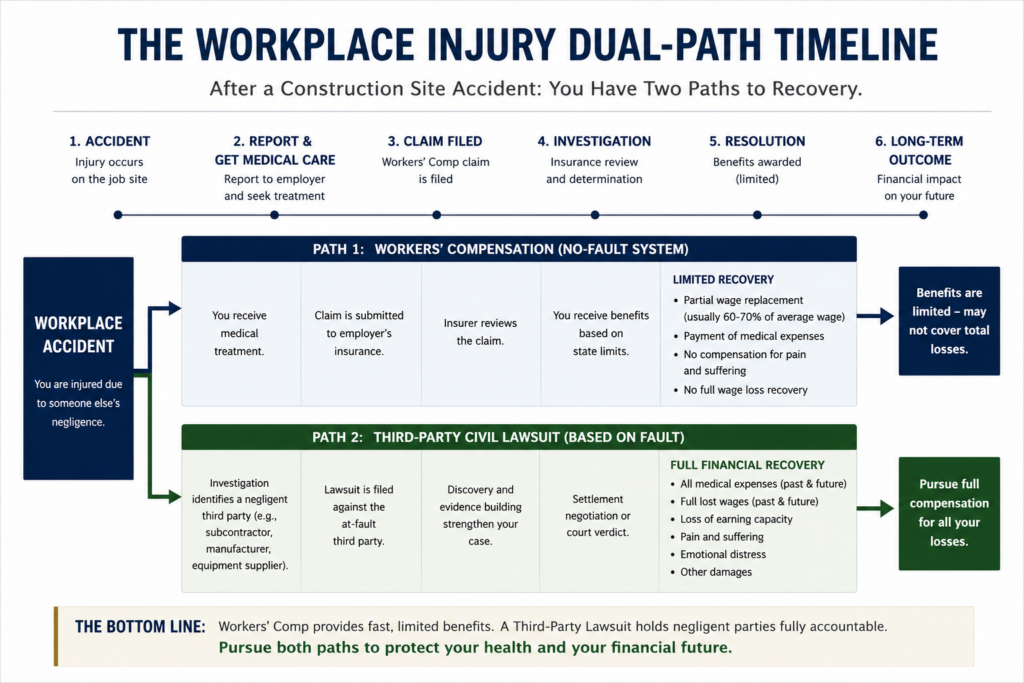
While workers’ comp provides immediate help, it acts as a very small financial safety net:
- Medical Expense Caps: The system pays for immediate treatments, but insurance adjusters regularly dispute specialized treatments, rehabilitation therapy, or long-term care plans.
- Partial Wage Recovery: Workers’ comp replaces only a fraction of your regular weekly income, usually capping your temporary total disability (TTD) payments. This partial benefit completely fails to account for your lost overtime pay, specialized skill differentials, or future promotion paths.
- Zero Noneconomic Payouts: The most glaring limitation is that the workers’ comp framework pays absolutely nothing for physical pain, emotional trauma, or the loss of enjoyment of life.
To understand how a full personal injury lawsuit calculates these deeper losses, review our guide on What Compensation Can You Recover for a Hawaii Personal Injury Case?.
Understanding Third-Party Liability on Multi-Employer Sites
The modern nature of building projects on Oahu works directly to your advantage if you are injured. Construction zones are rarely managed by just one company. Instead, they are multi-employer environments where employees from dozens of different independent businesses work alongside one another.
Under Haw. Rev. Stat. § 386-8, you retain the full legal right to sue any independent third party whose negligence contributed to your physical injuries. A third-party personal injury claim does not replace your workers’ comp file; rather, it runs parallel to it, allowing you to seek maximum compensation from the at-fault entity’s commercial liability coverage.
Common Third-Party Scenarios on Hawaii Jobsites
To successfully bypass the exclusive remedy limitations of workers’ comp, your legal team must identify an outside entity whose negligent choices caused your injury. Common real-world examples on local construction projects include:
1. Negligent Outside Subcontractors
If an independent concrete supplier, scaffolding assembly crew, or electrical subcontractor fails to secure their work zone properly, they can easily cause severe harm to other workers. For example, if a separate framing subcontractor drops a heavy tool from an un-railed platform and strikes you on the head, that business can be held liable in a third-party civil action.
2. Defective Tools, Scaffolding, and Heavy Machinery
When heavy machinery, power tools, safety harnesses, or cranes fail due to mechanical or manufacturing defects, the designer or manufacturer is responsible under strict product liability laws. If a scaffolding setup collapses despite being loaded well within its rated weight limit, your lawyer can sue the equipment manufacturer for your medical bills and trauma.
3. Negligent Delivery and Commercial Vehicle Drivers
Construction sites require constant deliveries of steel, concrete, and materials. If an independent flatbed truck driver or concrete mixer operator drives recklessly through a crowded job site on Oahu and pins you against a structure, their commercial auto policy can be targeted for full damages.
Comparing Your Legal Options: Workers’ Comp vs. Third-Party Lawsuits
To see how these two systems differ in scope, review this detailed comparison of benefits, requirements, and compensation structures:
| Feature | Workers’ Compensation Claim | Third-Party Personal Injury Lawsuit |
|---|---|---|
| Fault Requirement | No-Fault System: You receive benefits even if the accident was purely accidental or your mistake. | Fault-Based: You must prove an outside party’s negligence caused your physical injuries. |
| Medical Coverage | Covers reasonable, necessary treatments, but is heavily monitored by insurance adjusters. | Pursues full medical compensation, including future surgeries, specialized care, and modifications. |
| Wage Reimbursement | Replaces only a fraction of average weekly wages, capped by strict state statutory limits. | Replaces 100% of lost income, including lost overtime, future earning capacity, and benefits. |
| Pain and Suffering | Zero Allocation: Pays nothing for emotional distress, mental trauma, or physical pain. | Full Recovery: Pursues complete non-economic payouts for your true quality-of-life losses. |
| Target Entities | Your direct employer’s mandatory state workers’ compensation insurance policy. | Outside subcontractors, vehicle owners, equipment manufacturers, or property owners. |
Balancing Subrogation Liens and Your Ultimate Settlement
When you pursue a third-party lawsuit while receiving workers’ comp benefits, you must handle a specific legal rule called a workers’ compensation subrogation lien. Under Hawaii law, your employer’s insurance company has a legal right to be reimbursed for the medical bills and temporary disability payments they paid out to you once you win a settlement from the negligent third party.
This is where having an experienced trial attorney is essential. A skilled lawyer will step in to negotiate directly with the workers’ comp insurance carrier to reduce the size of their lien. By lowering what you owe the insurance company, your legal team ensures that the largest possible portion of the third-party settlement check goes directly into your pocket to secure your family’s future.
To see how our firm handles complex calculations like this, you can browse our long history of litigation on our Case Results section.
Protect Your Legal Rights: Contact Rosenberg Hoffman
If you have been seriously injured or lost a loved one in a construction accident on Oahu, do not rely on insurance adjusters or general contractors to explain your rights. Corporate insurance defense teams will move quickly to limit your case to a basic workers’ comp file, hoping you will overlook the third-party negligence that caused the crash or collapse.
At Rosenberg Hoffman, our Honolulu-based personal injury attorneys have been standing up for local commuters, construction workers, and families since 1995. We take over all communication with the insurance companies, secure vital site safety records, subpoena internal project logs, and build an unyielding case to protect your recovery.
We represent injury survivors across a full suite of local personal injury and transit categories. Whether your situation involves complex construction site actions, a devastating resort Slip/Trip-and-Fall Injury, or a catastrophic intersection collision involving Car Accidents, our team knows how to secure results.
We provide specialized representation for heavy commercial Truck Accidents, two-wheeled Motorcycle Accidents, and transit claims dealing with Moped, Bicycle, and Pedestrian Accidents or crashes caused by reckless Drunk Drivers. For traveling vacationers and active-duty service members, we provide focused counsel regarding Tourist and Military Injuries. If you were injured by an unleased animal, we manage Dog Bites and Attacks. In the most tragic instances, we provide compassionate, steady advocacy for families pursuing Wrongful Death actions.
When you choose our firm, you deal directly with your personal injury attorney from start to finish, never an assistant. We handle all injury litigation on a strict contingency-fee basis—you pay absolutely nothing upfront, and we collect zero legal fees unless we successfully win your financial settlement.
Call 808-470-4819 or visit https://rhlawhi.com/contact/ to schedule a free, 100% confidential case evaluation.
