

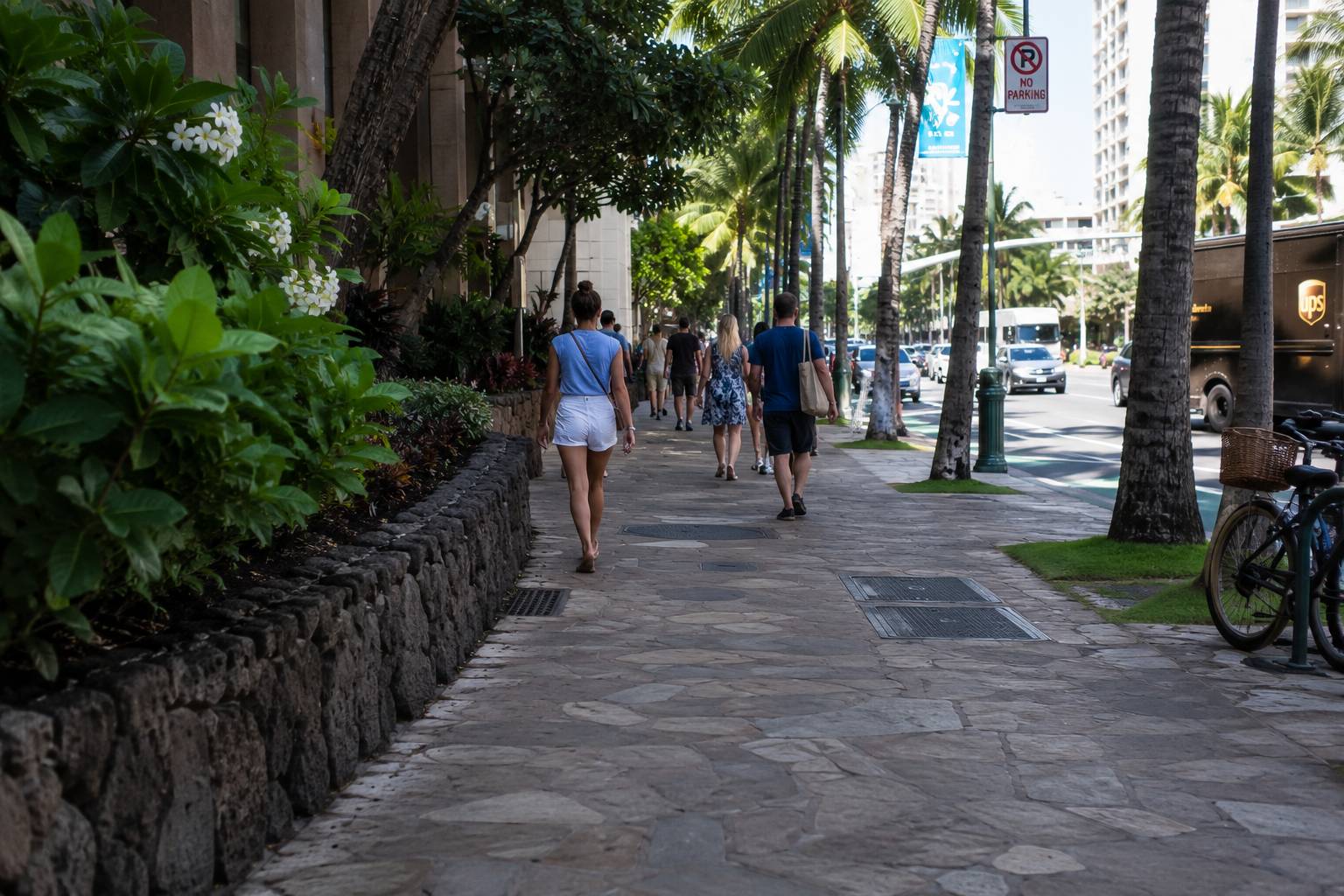
Walking along the public sidewalks of Honolulu—whether you are strolling through the busy retail corridors of Waikiki, commuting to work downtown near Bishop Street, or walking through your own residential neighborhood in Kapahulu—is a routine part of daily life. However, local foot traffic routes are often plagued by significant safety hazards. Raised concrete slabs cracked by massive tree roots, hidden potholes, pooled standing water from heavy rains, and accumulated commercial debris can instantly cause a severe slip, trip, or fall.
If you are recovering from a painful physical injury due to a poorly maintained walkway, you are likely facing costly medical treatments, physical therapy bills, and missed time from work. When you seek compensation for your losses, you will quickly hit a frustrating roadblock. The private property owner will typically claim the walkway belongs entirely to the government. Meanwhile, government adjusters will claim the adjacent business or homeowner is responsible for maintaining that exact stretch of pavement.
Under Hawaii premises liability law, sorting out who is to blame requires analyzing both state legal principles and municipal codes. Determining whether the City and County of Honolulu or the adjacent property owner is legally responsible for your fall depends entirely on the specific layout and the source of the danger.
The Core Rule: Public vs. Private Property Boundaries
The starting point for any Honolulu sidewalk accident claim is establishing legal ownership and control of the pavement where you fell. Property lines dictate which insurance network or legal entity must answer for the structural or operational defect that caused your accident.
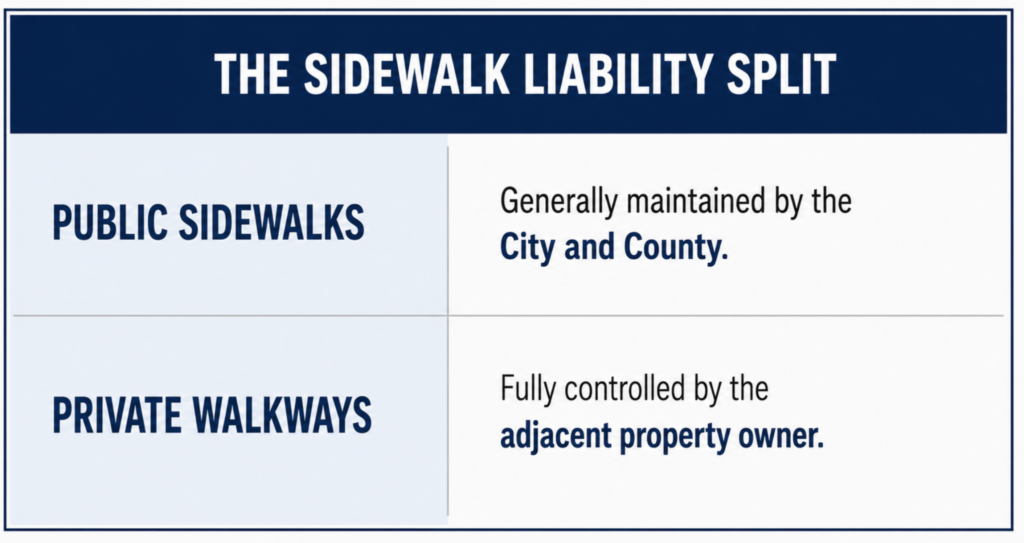
If your injury occurred on a dedicated public right-of-way, the City and County of Honolulu generally owes a duty to the public to keep its streets and walkways in a reasonably safe condition. However, if your fall occurred on a walkway located inside a commercial shopping plaza, a private apartment complex courtyard, or an easement controlled by a private business, the private property owner carries the full, direct burden of premises liability.
The Surprising Catch: Honolulu Municipal Code Requirements
Even when a sidewalk is technically part of a public right-of-way, local ordinances can shift specific maintenance duties onto private citizens and local business entities. The building and maintenance standards enforced by the City and County of Honolulu Department of Planning and Permitting outline clear expectations for adjacent landowners. Under the Revised Ordinances of Honolulu (ROH), adjacent property owners bear a distinct share of responsibility for keeping public pathways clear of immediate, transient hazards.
1. Debris, Liquid Spills, and Commercial Activities
Under local municipal codes, adjacent property owners or commercial tenants are strictly required to keep the sidewalks directly in front of their property clean and clear of walking hazards. If a local restaurant washes greasy floor mats on the public walkway, or a shop owner allows trash, loose gravel, or slippery liquids to accumulate on the pavement, the private business owner can be held fully liable if a pedestrian slips and falls on that hazard.
2. Structural Defects and Major Cracks
If your trip and fall was caused by a major structural defect—such as a concrete slab that has lifted several inches due to a city-planted street tree—the legal blame usually stays with the City and County of Honolulu. Municipalities are responsible for structural repairs, leveling uneven concrete, and fixing deep potholes on public paths.
The Critical Challenge: Filing Claims Against the Government
If your investigation reveals that the City and County of Honolulu is the negligent party, you must move quickly to protect your claim. Suing a government entity in Hawaii is drastically different from pursuing a private insurance company due to strict statutory rules and immunities.
Under Haw. Rev. Stat. § 46-72, you cannot file a direct lawsuit against the county unless you present a formal, written notice of your claim to the county clerk within two years of the date of your injury.
This written notice must be incredibly detailed, documenting the exact time, date, precise location, and specific cause of the injury, along with an itemized list of your medical damages. Failing to submit this formal notice within the strict two-year window will completely bar you from recovering a settlement, no matter how severe your physical injuries are.
Quick Reference: Sidewalk Injury Liability Scenarios
To help you understand who is responsible for different walkway hazards, review this simplified breakdown of common accident scenarios:
| Sidewalk Hazard Type | Sidewalk Hazard Type | Legally Responsible Party |
|---|---|---|
| Concrete slab lifted by a city-planted tree root | The city will argue they had no notice of the defect. | City & County of Honolulu: Responsible for major structural repairs on public rights-of-way. |
| Gravel and trash accumulated outside a retail storefront | The business will claim it is a public sidewalk. | Private Property Owner: Required by local municipal codes to keep adjacent paths clear of debris. |
| Uneven concrete walkways inside a private shopping center | The landlord will try to blame the victim’s shoes. | Private Business Owner: Holds full, unmitigated premises liability for all internal walkways. |
Overcoming the Comparative Negligence Defense Strategy
Whether you file a claim against the city or a private commercial insurance policy, the defense lawyers will use Haw. Rev. Stat. § 663-31, Hawaii’s 51% Modified Comparative Negligence Rule, to try to defeat your case. They will argue that you were looking at your phone, walking too fast, or ignoring an obvious crack to pin 51% or more of the blame on you. If they succeed, they will not have to pay you anything.
To counter these tactics, our personal injury lawyers systematically gather objective evidence. We document the hazard immediately with high-definition photos, pull public records to see if others have complained about the same broken sidewalk, and track down nearby surveillance footage to prove exactly what caused your fall.
Unlike car accidents, sidewalk slip and falls bypass the initial no-fault auto limits, allowing you to seek direct compensation for your total medical expenses, lost wages, and overall quality-of-life losses from day one. To see how these final numbers are structured, read our guide on What Compensation Can You Recover for a Hawaii Personal Injury Case?.
Real Trust: Persistent Representation Grounded in Aloha
Challenging powerful corporations, government entities, and out-maneuvering complex insurance defense networks requires an experienced local trial team. You can evaluate our successful history across a wide range of personal injury actions by reading our client stories.
Read Mark C.‘s review of Rosenberg McKay Hoffman on Yelp Read Gayle N.‘s review of Rosenberg McKay Hoffman on Yelp Read Diana C.‘s review of Rosenberg McKay Hoffman on YelpProtect Your Legal Recovery: Contact Rosenberg Hoffman
If you are recovering from a severe sidewalk fall on Oahu, do not let corporate adjusters or government risk managers give you the runaround. They will often try to pass the blame back and forth until your statutory deadlines pass, permanently destroying your ability to cover your medical costs.
At Rosenberg Hoffman, our Honolulu-based personal injury attorneys have been protecting accident victims and local commuters since 1995. We handle all direct communication with the city and private insurance networks, investigate property lines, secure vital maintenance logs, and build an unyielding case to protect your financial recovery.
We represent injury survivors across a full suite of local personal injury and traffic categories. Whether your situation involves a public Slip/Trip-and-Fall Injury, a catastrophic multi-vehicle collision under Car Accidents, or a severe crash caused by reckless Drunk Drivers, our team knows how to secure results.
We provide specialized representation for heavy commercial Truck Accidents, two-wheeled Motorcycle Accidents, and transit claims dealing with Moped, Bicycle, and Pedestrian Accidents. For active-duty service members and traveling visitors, we provide focused counsel regarding Tourist and Military Injuries. If your injury involved an unleased animal, we handle Dog Bites and Attacks. In the most heartbreaking instances, we stand beside families to seek accountability through Wrongful Death actions.
When you choose our firm, you deal directly with your dedicated trial attorney from start to finish, never an assistant. We handle all injury litigation on a strict contingency-fee basis—you pay absolutely nothing upfront, and we collect zero legal fees unless we win your financial settlement.
Call 808-470-4819 or visit https://rhlawhi.com/contact/ to schedule a free, 100% confidential case evaluation.
