

Imagine you are driving through an intersection near Ala Moana Center in Honolulu when another motorist runs a red light and broadsides your vehicle. You sustain severe injuries, face mountain-high medical charts, and miss weeks of work. It seems like a clear-cut legal case. However, during the insurance investigation, the adjuster uncovers traffic camera footage showing you were traveling roughly 5 miles per hour over the speed limit at the time of the collision.
Suddenly, the auto insurance company shifts its tactics. They argue that because you were speeding, you are partially to blame for the crash. They threaten to reduce your payout or deny your claim completely.
This stressful scenario highlights one of the most critical legal frameworks in local tort law: Hawaii’s 51% Modified Comparative Negligence Rule.
Under Haw. Rev. Stat. § 663-31, your financial recovery after a car crash, slip-and-fall, or motorcycle accident is directly tied to your percentage of fault. If you are found even partially responsible for your accident, it fundamentally changes how much money you can recover—and if you cross a specific statistical threshold, you will get nothing at all. Understanding this law is essential if you want to protect your personal injury settlement.
What is Modified Comparative Negligence?
In personal injury law, states determine fault using different legal doctrines. Some states use “contributory negligence,” an aggressive rule where if an accident survivor is even 1% at fault, they are legally barred from recovering a single penny. Other states use “pure comparative negligence,” allowing you to recover compensation even if you were 99% responsible for the wreck.
Hawaii operates under a middle-ground framework known as modified comparative negligence, specifically utilizing the 51% bar rule.
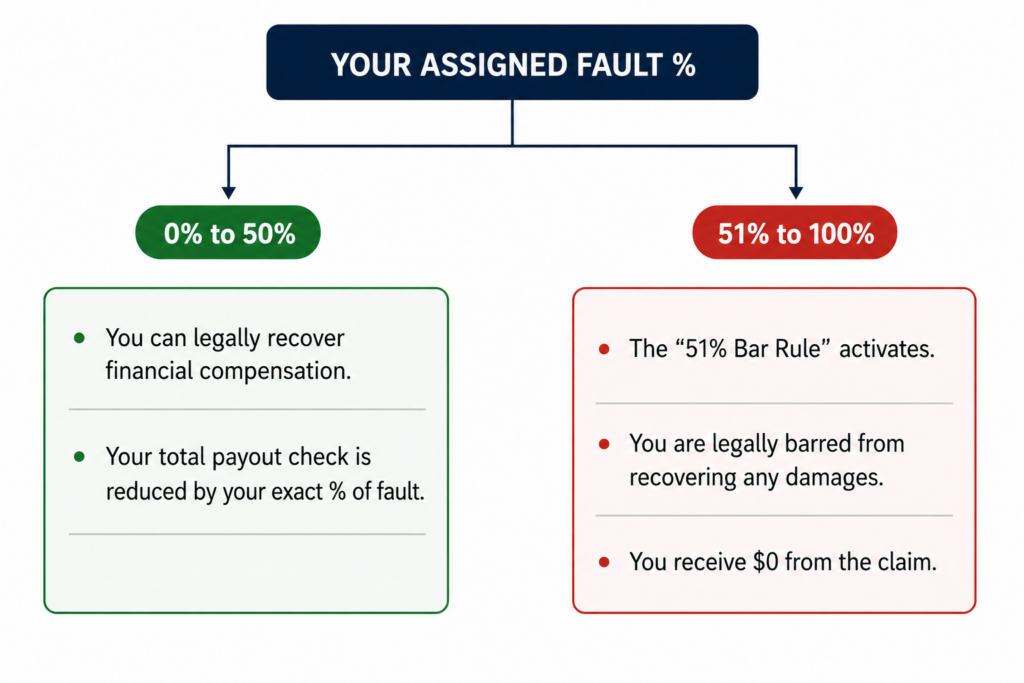
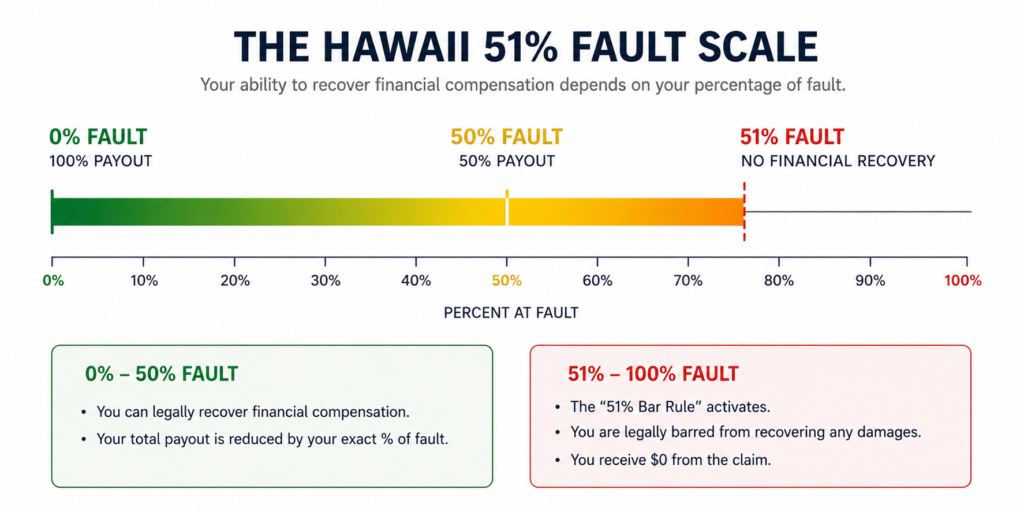
Under this local standard, an injured party can legally seek financial damages from an at-fault driver or property owner as long as the injured party’s share of the blame does not exceed 50%. If you are found 50% or less at fault, you can recover compensation, though your final settlement check is reduced by your exact percentage of liability. However, the moment you hit 51% or more of the blame, your right to sue is completely erased, and you cannot collect any compensation from the other party.
How the 51% Rule Directly Cuts Your Settlement Check
To understand how this law impacts your wallet, you have to look at the math behind a personal injury evaluation. When an injury claim goes before a judge or a jury in a Hawaii circuit court, the fact-finders are required to answer two distinct questions:
- What is the total dollar amount of the victim’s economic and non-economic damages?
- What exact percentage of fault belongs to each party involved in the accident?
Once those numbers are locked in, your payout is adjusted dynamically. Let’s look at three realistic case studies tracking how this rule functions on Oahu:
Scenario A: The Flawless Claimant (0% Fault)
You are stopped at a red light on the Kamehameha Highway in Pearl City when a distracted driver rear-ends your car. The jury determines your total medical bills, lost wages, and pain and suffering equal $100,000. Because you carry 0% fault, you recover the full $100,000.
Scenario B: The Partially Blamed Claimant (30% Fault)
You are driving through a Honolulu intersection when a delivery truck turns left directly in front of you. However, you were briefly looking down at your dashboard navigation system. The court determines your total injury damages are $100,000, but assigns you 30% of the blame for being distracted, while assigning the delivery truck 70% of the blame.
- The Math: Your $100,000 award is reduced by 30% ($30,000).
- Your Final Payout: You receive $70,000.
Scenario C: Tragic Elimination via the 51% Bar (51% Fault)
You are walking across a dark section of Nimitz Highway at night outside of a designated crosswalk when an speeding vehicle strikes you. The jury calculates your catastrophic medical losses at $500,000. However, because you were jaywalking in a dark area, the jury determines you were 51% responsible for your own injuries, while the speeding driver was 49% responsible.
- The Result: Because your fault crossed the 51% threshold, your recovery is completely dropped to $0. You are left responsible for your entire medical debt.
Quick Reference: Fault Percentages and Financial Payouts
| Your Assigned Fault % | Total Case Damages | Statutory Eligibility | Your Final Financial Recovery |
|---|---|---|---|
| 0% Fault | $150,000 | Fully Eligible | $150,000 (Full Settlement) |
| 10% Fault | $150,000 | Eligible (10% Reduction) | $135,000 |
| 25% Fault | $150,000 | Eligible (25% Reduction) | $112,500 |
| 50% Fault | $150,000 | Eligible (Maximum Limit) | $75,000 (50% Payout) |
| 51% Fault | $150,000 | Barred via § 663-31 | $0 (Claim Denied) |
| 90% Fault | $150,000 | Barred via § 663-31 | $0 (Claim Denied) |
How Insurance Adjusters Weaponize Comparative Fault to Avoid Payouts
It is crucial to realize that insurance adjusters are fully aware of how the 51% rule works, and they utilize it as a primary financial shield. Auto insurance providers are for-profit corporations whose ultimate goal is to minimize their payouts to preserve their corporate bottom line.
When you file a car accident claim on Oahu, the opposing insurance company’s investigators will dissect every piece of available evidence to shift as much blame to you as possible. They do this for two strategic reasons:
- To Chip Away at Your Payout: Every single percentage point of fault they can pin on you directly saves their company money. If they can successfully argue that you were 20% responsible for an accident because you didn’t swerve fast enough, they instantly save 20% on your personal injury settlement.
- To Force a Total Claim Denial: If an insurance adjuster can uncover or manipulate enough circumstantial evidence to push your assigned fault to 51%, they escape the claim completely. They will issue a formal liability denial letter, leaving you with zero leverage unless you file a formal lawsuit.
Common Tactics Adjusters Use to Shift Blame:
- The Recorded Statement Trap: An adjuster will call you shortly after a crash under the guise of “helping process your claim.” They will ask open-ended, confusing questions designed to get you to say phrases like “I didn’t see them coming” or “I guess I could have stopped sooner,” which they will later use as admissions of comparative fault.
- Delaying and Tracking Medical Treatment: If you delay going to an emergency room or a local Oahu urgent care clinic after a collision, the insurance company will argue that you failed to mitigate your damages or that your injuries happened elsewhere, shifting blame for your medical complications to your own behavior.
- Exploiting Pre-Existing Conditions: They will comb through your historical medical charts to claim your current back pain or neck injury is entirely an old issue, arguing that you are wrongfully trying to blame their policyholder for a long-standing physical condition.
How an Experienced Honolulu Injury Lawyer Defends Your Case
When an insurance company uses comparative negligence tactics to target your settlement, you cannot fight back effectively without an aggressive legal team. At Rosenberg Hoffman, we understand how to counter corporate insurance playbooks and build ironclad cases that protect the true narrative of your accident.
To ensure the insurance adjusters do not unfairly inflate your fault percentage, our local trial lawyers execute a robust, comprehensive investigative approach:
- Securing Immediate Digital Evidence: We move quickly to download local traffic camera recordings, subpoena commercial vehicle black box data, and pull nearby business surveillance videos before files are deleted or overwritten.
- Employing Accident Reconstruction Specialists: We collaborate with top-tier engineering experts to reconstruct the physics of your crash. These specialists analyze skid marks, crush patterns, vehicle weights, and braking distances to prove mathematically that the other driver caused the collision.
- Gathering Definitive Witness Statements: We track down and interview neutral bystanders who witnessed the incident, securing clear statements before witnesses leave resort areas or forget key details.
- Navigating Local Traffic Codes: We establish clear violations of local safety laws, showing that the defendant’s actions—such as running a light, driving under the influence, or texting while driving—represent the overwhelming, proximate cause of the trauma
Real Trust: What Our Clients Say About Our Representation
When fighting against multi-billion-dollar corporate insurance networks on Oahu, experience and tenacity are what win cases. Here is how our legal team has successfully stood up for injured individuals and families across Hawaii:
Unwavering Persistence on Difficult Claims: “No one took the time to take my daughter’s case. McKay was persistent and was able to get a settlement for my daughter… thank you all for your hard work and persistence. Justice is served.”
— Alvin J., Verified Google Review via Attorney at Law
Providing Clarity Through Chaos: “Thank you and thank you so much for everything! Helping us through a rough patch, great service, and finding resolution and closure to this chaotic situation.”
— Makana K., Verified Yelp Review via Attorney at Law
Protect Your Payout: Schedule a Free, Confidential Consultation Today
If you are dealing with the physical and emotional aftermath of a major motor vehicle accident or slip-and-fall on Oahu, do not try to out-negotiate an insurance adjuster on your own. A single misstatement can accidentally push your case past the 51% fault line, completely destroying your ability to collect a settlement.
Allow our local personal injury team to insulate you from the insurance companies, protect your rights, and pursue every single dollar of financial compensation you are legally owed under Hawaii law.
At Rosenberg Hoffman, we bring over 100 years of combined legal experience to your fight. When you work with our firm, you speak directly with your attorney, never a paralegal. We manage your entire claim from start to finish so you can focus exclusively on your medical rehabilitation.
We protect injury survivors from our central offices in downtown Honolulu and Waipahu. We handle all personal injury cases on a strict contingency-fee basis—you pay absolutely nothing upfront, and we collect zero legal fees unless we successfully win your civil case.
